

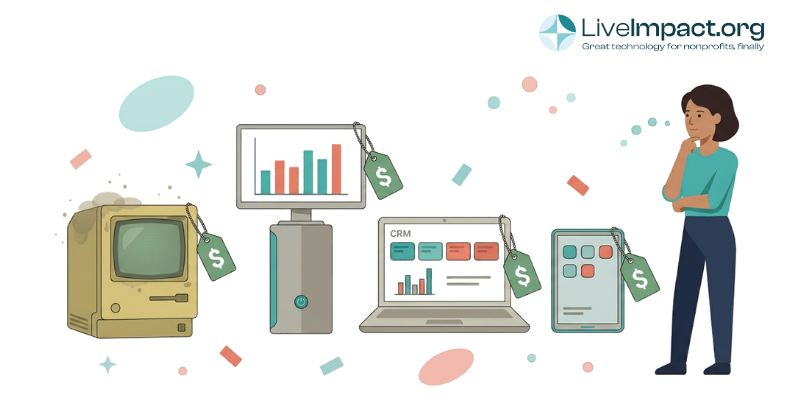
Nonprofit CRM software typically costs between $100 and $500 per month for small to mid-sized organizations, though the advertised price rarely reflects what you’ll end up paying. Pricing models vary widely across vendors. Some charge per user, others per contact record, and others charge a flat monthly rate regardless of how many people access the system. Understanding those structural differences matters more than comparing sticker prices. According to Wipfli’s 2026 State of Nonprofit research, 60% of nonprofit executive leaders cite cost as their primary technology infrastructure challenge. That number makes sense when pricing structures are built to make comparison difficult. This guide breaks down what each model means for your budget, where costs hide, and what to ask before signing anything.
What Are the Main Nonprofit CRM Pricing Models?
Before comparing specific platforms, it helps to understand the four pricing structures you’ll encounter most often. The model a vendor uses shapes your long-term costs more than the monthly rate on their website.
Here’s how each one works in practice:
- Per-user pricing charges based on the number of people who need a login. Costs scale as you add staff, bring on board members, or try to give volunteers read-only access. Organizations end up restricting who can see their own data because adding logins costs money. That creates a workflow problem disguised as a pricing problem.
- Per-contact (record-based) pricing ties your bill to the size of your database. Platforms using this model start at one price for a small number of records and increase significantly as your contact list grows. It creates a counterproductive incentive to delete donor history just to stay under a pricing tier.
- Revenue-based pricing scales with your organization’s annual fundraising total. The logic is that it ties cost to organizational capacity. The problem is that it penalizes growth periods, precisely when nonprofits most need their tools and can least afford higher costs.
- Flat-rate pricing charges one monthly or annual fee regardless of how many users access the system or how many records you store. It’s the most budget-predictable structure for growing organizations and the model that creates the fewest perverse incentives.
The table below summarizes how these four models compare across the factors that matter most for small nonprofits.
Nonprofit CRM Pricing Models Compared
How the four main structures affect your budget over time
| Pricing Model | How It Works | Main Risk | Budget Predictability | Growth Friendly |
|---|---|---|---|---|
| Per-User | Fee per staff member, board member, or volunteer login | Costs rise every time headcount grows; organizations limit access to control bills | ⬤ | ⬤ |
| Per-Contact | Fee scales with number of records stored in the system | Organizations delete donor history to avoid tier increases; database growth becomes a budget conversation | ⬤ | ⬤ |
| Revenue-Based | Fee tied to annual fundraising revenue | Penalizes successful fundraising periods and strong growth years | ⬤ | ⬤ |
| Flat-Rate | One fee regardless of users, contacts, or revenue | Fewer risks overall, though module add-ons can raise costs if features are sold separately | ⬤ | ⬤ |
⬤ Moderate / Variable
⬤ Weak / At Risk
Growth friendly: ⬤
Growth friendly: ⬤
Growth friendly: ⬤
Growth friendly: ⬤
If you’re early in your search, understanding how these models interact with your growth trajectory is one of the most valuable things you can do before taking vendor demos. The best CRM options for small nonprofits vary significantly on this dimension, and the right model depends on how you expect your team size and database to grow over the next few years.
How Much Does Nonprofit CRM Software Cost Per Year?
For most small nonprofits, annual CRM subscription costs fall somewhere between $1,200 and $5,600 depending on the platform and tier. Mid-size organizations with larger databases or more users often land higher within that range or above it.
Enterprise platforms land in a different category entirely. Salesforce offers 10 free licenses through its Power of Us program, which sounds appealing, but most nonprofits will eventually need more than 10 seats, and making Salesforce functional for nonprofit workflows typically requires significant customization. Implementation costs for that work can run from tens of thousands of dollars to considerably more depending on complexity. Other enterprise-grade platforms carry similar dynamics: subscription rates that look manageable until you factor in the setup, training, and ongoing admin costs required to operate them.
Subscription costs are also only part of the picture. Total cost of ownership for most platforms includes implementation, data migration, training, add-on features, and payment processing fees, none of which typically appear in the advertised price.
What Hidden Costs Do Nonprofits Miss When Budgeting for CRM Software?
The gap between what nonprofits expect to pay and what they actually pay comes down to costs vendors don’t volunteer upfront. The most common ones to ask about before signing:
- Implementation and data migration. Getting your existing data into a new system can range from genuinely free (self-serve tools with solid documentation) to several thousand dollars depending on data volume and vendor support models. Always ask: “What does it cost to get our existing data into your system, and who does that work?”
- Training. Many platforms offer basic onboarding but charge separately for hands-on training, especially for staff beyond the initial setup team. Ask whether training is included and what happens when you hire someone new six months from now.
- Features behind paywalls. Some platforms advertise a low base price but put essential functionality behind additional paywalls. Things like advanced reporting, email marketing, event management, or integrations may cost extra beyond the base tier. Ask vendors to walk you through exactly which features are included at the tier you’re considering and which require an upgrade.
- Payment processing fees. If you’re processing donations through the platform, some vendors take a percentage on top of credit card processing fees. Calculate this as part of your annual cost, especially if your donation volume is significant.
- Integration costs. Connecting your CRM to email tools, accounting software, or other systems can carry additional charges, either through paid integrations or custom development work.
- Overage charges. On tiered pricing models, exceeding your contact or email limit mid-year can trigger unexpected charges. Ask what happens when you cross a threshold and how much advance notice you’ll receive.
For a more detailed breakdown of what implementation actually costs across different platform types, the post on upfront and hidden costs of software implementation covers this in more depth.
How Does Per-User Pricing Affect Nonprofit Budgets Over Time?
Per-user pricing feels manageable for a team of three. Add two staff members in year two, bring on five board members who need read access, and the math changes quickly. For volunteer-heavy organizations, it changes even more dramatically.
The deeper problem with per-user pricing is behavioral. When every login costs money, organizations stop giving people access to the information they need. One staff member ends up running all the reports because adding more logins costs money. Program managers can’t see their own data without going through a gatekeeper. That’s a real operational cost that doesn’t show up as a line item in your software budget, but it’s there every time someone waits on a report they could have pulled themselves.
Flat-rate pricing removes that dynamic entirely. Adding a new staff member, board member, or volunteer costs nothing extra, which means the people who need data can actually get to it.
What Happens to Your Price When Your Database Grows?
Record-based pricing feels fair at the start because small organizations have small databases. A food bank with 500 clients or a development office with 800 donor records fits comfortably in the entry tier. The problem surfaces when that database grows to 3,000 clients or crosses a donor record threshold the vendor uses to move organizations into a higher pricing bracket.
The downstream effect is worse than the higher bill. Organizations start making decisions about their data based on pricing rather than program needs. Old donor records get deleted to avoid a tier increase. Clients who haven’t engaged in a year get removed from the system. The institutional knowledge embedded in that historical data disappears, and recovering it later is hard.
According to Zylo’s 2025 SaaS Management Index, rapid software adoption, particularly around AI-powered tools, is also accelerating vendor lock-in, leaving organizations with limited bargaining power once they’re embedded in a platform. Choosing a pricing model that doesn’t penalize growth is one way to retain leverage in those vendor relationships over time.
What Should Nonprofits Know About CRM Contract Terms Before Signing?
Contract terms are where a lot of nonprofits get surprised, and vendors rarely bring them up during the sales process. A few things worth understanding before you commit:
Annual vs. multi-year contracts. Some vendors push two- or three-year agreements. Without a price cap written into the contract, the vendor can raise rates significantly at renewal and the organization either pays or faces a costly migration. Auto-renewal clauses with price increase provisions are worth flagging specifically.
Annual price increase rates. The broader SaaS market raised prices at roughly 11.4% in 2025, nearly five times the general inflation rate in G7 countries, according to SaaStr’s analysis of the 2025 pricing surge. Nonprofits on multi-year agreements without rate caps are exposed to that trend. Ask vendors to transparently disclose their standard annual increase rate upfront, and ask whether a cap is available in writing.
Data portability. What happens if you want to leave? Some vendors charge data export fees or store data in proprietary formats that make migration expensive. Before signing, ask whether you can export your full data at any time and whether there’s a fee to do so.
Seeing what a platform migration actually looks like in practice is one of the more useful things you can do during your evaluation. The post on what a real platform migration looks like covers a firsthand account of switching from Salesforce that’s worth reading before committing to any long-term agreement.
A few specific questions worth asking any vendor before you sign:
- What is your standard annual price increase rate?
- Is there a cap on renewal increases that can be written into the contract?
- What triggers a tier change, and how much notice will we receive?
- Can we export our full data at any time, and is there a fee to do so?
- What is included in onboarding, and what costs extra?
Is Paying for Features You Don’t Use a Hidden Cost?
Many platforms bundle functionality into a single package and charge for all of it regardless of what your organization actually uses. Paying for 12 features when you use 4 is a real cost, even if it doesn’t show up as a line item. It also creates friction for staff who have to navigate features that have nothing to do with their work.
Modular pricing offers an alternative. Rather than buying a fixed bundle, you pay for the modules your programs actually need and add capabilities as your organization grows. The practical benefit is that your software costs track your actual program footprint rather than someone else’s estimate of what you might eventually want.
The tradeoff is that you need to be clear on your requirements before vendor conversations. Knowing which features are truly essential versus nice-to-have keeps you from underbuying (and having to upgrade expensively later) or overbuying from the start. Understanding what to look for in all-in-one nonprofit software before evaluating specific vendors makes those conversations considerably easier.
How Should a Small Nonprofit Budget for CRM Software?
A realistic budget accounts for more than the monthly subscription. Before presenting numbers to your board, calculate your three-year total cost of ownership: subscription costs across all three years (factoring in likely price increases), implementation and data migration, initial training, and any add-on modules you expect to need.
Technology investment remains a challenge across the sector. The NTEN 2024 Nonprofit Digital Investments Report found that 45% of nonprofits say they aren’t spending enough on technology, with 77% citing budget as the primary barrier. That gap matters because underspending on the right tool often costs more in staff time than the software would have.
A few questions worth bringing to your board when making the case for a new platform:
- What is our three-year total cost, including implementation and training?
- What does staying on our current system cost us in staff hours, workarounds, and reporting errors?
- What happens to our software costs if our team or database grows by 50% in the next two years?
- Does this vendor disclose their annual price increase rate, and is there a contractual cap?
Free tools also carry real costs. Staff time spent on manual workarounds, spreadsheet maintenance, and data reconciliation is a real monthly cost, even when it goes untracked in a formal software budget. The right calculation compares the total operational cost of your current approach against the total cost of the new one, not just the subscription fee in isolation.
Frequently Asked Questions About Nonprofit CRM Pricing
How much does nonprofit CRM software cost?
Most small nonprofits pay between $1,200 and $3,600 per year for a mid-tier CRM subscription, not counting implementation, training, or add-ons. Enterprise platforms carry significantly higher total costs once setup and ongoing administration are factored in.
What is the cheapest nonprofit CRM?
Free options like HubSpot CRM exist but lack nonprofit-specific features such as case management, grant tracking, and outcome reporting. Budget-focused paid options start around $100 per month, though what’s included at that price point varies considerably across vendors.
Is Salesforce free for nonprofits?
Salesforce offers 10 free licenses through its Power of Us program, but most nonprofits need more than 10 seats, and making Salesforce functional for nonprofit workflows typically requires significant customization. Implementation costs for that work can run from tens of thousands of dollars to considerably more, depending on complexity.
What is flat-rate nonprofit CRM pricing?
Flat-rate pricing means one monthly or annual fee regardless of how many users access the system or how many records you store. It’s the most budget-predictable option for growing organizations and removes the financial disincentive to give your full team access to the data they need.
What questions should I ask a CRM vendor about pricing?
Ask about annual price increase rates, whether a cap is available in writing, what triggers a tier change, how much notice you’ll receive before a price change, whether data export is free if you leave, what’s included in onboarding, and which features require additional payment beyond the base subscription.
What is the total cost of ownership for nonprofit CRM software?
Total cost of ownership includes subscription fees across multiple years, implementation and data migration costs, staff training, add-on features or modules, payment processing fees if applicable, and integration costs for connecting to other tools. Year-one subscription price is often the smallest component of what organizations actually spend over a three-year contract.
What to Do Before You Sign
Nonprofit CRM pricing is more navigable than vendors make it appear. The organizations that end up with the best outcomes typically calculate their three-year total cost before comparing monthly rates, ask vendors direct questions about price increases and data portability, and match the pricing model to how they expect to grow rather than just to their current size.
LiveImpact’s flat-rate, modular pricing is built around the principle that your costs shouldn’t grow just because your team or your database does. No per-user fees, no contact record tiers, and the case management module built into the platform rather than sold as a separate add-on. If you want to see how the pricing model works in the context of your organization’s actual programs and team size, request a demo and we’ll walk through it with you.