

Nonprofits running housing, homelessness, youth, or human services programs often hold grants from several government funders at once, each with its own reporting schedule, outcome metrics, and audit requirements. Grant compliance management software that ties funder requirements directly to client and program data removes the spreadsheet-per-funder approach that causes missed deadlines and reporting errors. If your team is copying the same client data into three different report templates every quarter, the system they’re working with is usually the real bottleneck.
Why does managing multiple government grants get so complicated?
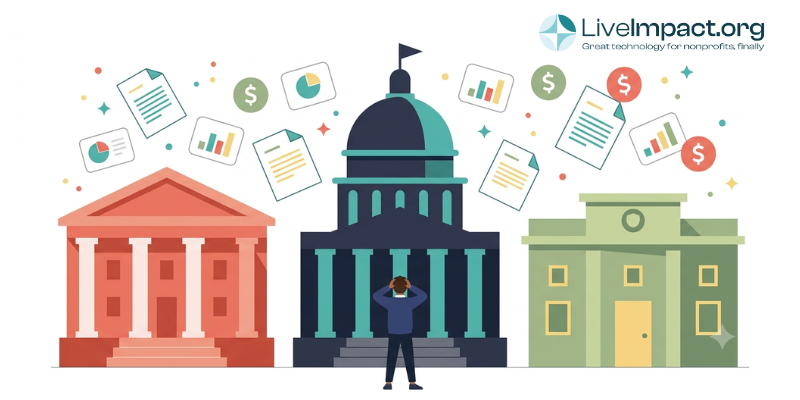
Picture a housing program juggling a HUD Continuum of Care grant and a state homelessness assistance grant. The HUD grant requires HMIS-aligned data and an Annual Performance Report tied to federal fiscal year timelines. The state grant runs on a different fiscal calendar, tracks a separate set of outcome measures, and expects its own report format entirely. Add a county contract on top of that, and a single case manager might document one client interaction three separate ways depending on which funder is asking.
Roughly 30% of nonprofits that file a full IRS Form 990 report receiving government grant funding, and those grants total over $300 billion annually across the sector, according to Candid’s research. That volume of public funding comes with real reporting weight. Federal agencies each set their own performance and financial reporting cadence, and HUD guidance specifically requires that agencies blending multiple funding sources document which hours and activities apply to which grant within each client file. When that documentation lives in disconnected spreadsheets, reconciling it before an audit turns into a scramble.
The 2025 funding landscape made this even more visible. Nonprofits that experienced government funding disruptions reported a less stable staffing outlook and were more likely to scale back programs, according to Urban Institute research on nonprofits navigating grant freezes and delays in early 2025. Organizations that already had clean, funder-separated documentation were better positioned to respond quickly when a grant status changed. Organizations still piecing together spreadsheets were not.
What does grant compliance tracking look like inside case management software?
Grant compliance management software tags each client record, service note, and outcome metric to the funding source that pays for it. Instead of exporting client data into a separate grant tracker and manually matching it against reporting requirements, the software pulls the report directly from live program data because the funding tags are already attached at the point of service.
This matters most for the reconciliation step that eats up so much staff time. A case manager entering a service note doesn’t need to remember which of four report templates that note eventually feeds into. The system already knows, because the grant relationship was configured once rather than recreated by hand every reporting period. That configuration is what separates grant tracking built into a case management platform from a grant tracker bolted on as an afterthought. LiveImpact’s approach ties grant-specific reporting requirements to the same client and program data your staff already enter, so funder reports pull from one consistent source rather than a patchwork of exports.
How do multi-program nonprofits keep grants and case management organized?
Organizations running more than one program under different funding streams face this problem constantly, and the specifics look different depending on the program type.
Housing and homelessness programs often juggle HUD Continuum of Care funds, Emergency Solutions Grants, and state homelessness dollars, each with its own definition of a successful outcome. Our guide to housing and shelter case management software covers how these programs structure client records to satisfy HMIS requirements without duplicating data entry across funders.
Youth-serving organizations frequently blend federal funding with foundation grants that carry their own age-specific tracking and consent requirements. Our guide to human services case management software walks through how youth programs and similar human services organizations structure intake and outcome tracking for mixed funding sources.
Human services and social work agencies often layer county contracts on top of state and federal grants, each demanding its own outcome definitions and audit trail. Our complete guide to case management software for social workers covers how these agencies keep government-funded program requirements straight without adding administrative headcount.
Across all three, the pattern repeats. The pattern usually comes down to software that treats every grant as a separate reporting obligation instead of a shared layer sitting on top of the same underlying client and service data. Program staff are already stretched thin managing that complexity by hand.
What should you look for in software that handles multi-funder grant compliance?
Not every case management platform handles multi-funder compliance the same way. Before you evaluate vendors, look for these specific capabilities:
- Funder-specific reporting templates. The software should generate reports formatted to each funder’s requirements, rather than exporting raw data you then reformat by hand.
- An audit trail tied to each grant. Every service note, document, and outcome entry should show which funding source it maps to, so an auditor can trace a client’s record back to the correct grant without a manual walkthrough.
- Deadline tracking scoped to each grant. A single organization-wide calendar struggles to handle a HUD report due quarterly alongside a state grant that reports annually. Deadlines need to live at the grant level.
- Outcome reporting mapped to each funder’s metrics. One funder may care about housing placement rates while another tracks employment outcomes. The platform should let you configure outcome fields per grant rather than forcing every program into one generic outcome structure.
Our comparison of grant management software options for nonprofits breaks down how different platforms handle these requirements if you want a closer look at specific vendors before you commit.
Is it worth switching from spreadsheets before your next audit?
Spreadsheets can work when you’re managing one grant with one reporting cycle. Add a second funder, and the manual reconciliation starts eating hours every month. Add a third, and it usually eats a full-time role’s worth of attention that could otherwise go toward client-facing work.
Auditors don’t just check whether the numbers add up. They check whether you can trace any given number back to its source, and whether that trail holds together across every funder you report to. Spreadsheets that live on individual staff computers, get updated inconsistently, or rely on manual copy-paste between tools tend to fall apart under that kind of scrutiny, even when the underlying work was done well.
A few signs your organization has outgrown the spreadsheet approach:
- Staff spend more time reformatting data for different funders than serving clients
- Report deadlines have been missed or nearly missed in the last year
- Different staff members maintain separate versions of the same client’s funding documentation
- Your last audit involved reconstructing which hours and services applied to which grant after the fact
If any of those sound familiar, switching before your next audit cycle, rather than during it, gives your team time to configure the system properly and train on it without deadline pressure. A case management platform built around your specific programs can be configured to your existing grant structure rather than forcing your programs to adapt to someone else’s template. If you want to see how that setup process works for an organization managing multiple government funders, a demo is the most direct way to find out.
Frequently asked questions
Do I need separate software for each government grant I manage?
No. Case management software built for multi-funder compliance lets you track reporting requirements, deadlines, and outcome metrics for each grant within one system, rather than maintaining separate spreadsheets or tools per funder. This reduces the risk of missed deadlines and makes audits faster to prepare for.
What’s the difference between grant management software and case management software with grant tracking?
Standalone grant management software tracks deadlines and documentation but rarely connects to client or program data. Case management software with built-in grant tracking ties funder compliance directly to the service delivery data funders actually want to see, which cuts down on manual reporting work.
Can one system handle grants from different government agencies with different reporting requirements?
Yes, if the software supports configurable reporting templates per funder. This matters most for organizations receiving federal, state, and county funding simultaneously, since each level of government typically has different documentation and outcome-reporting standards.