


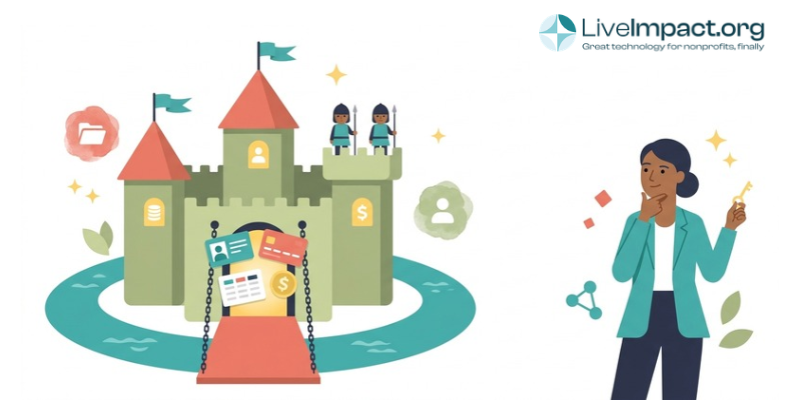
Your nonprofit should own the records it enters into a vendor’s software. Whether you can take those records with you in a usable form when you leave depends on your contract terms. Five terms decide it:
- Who owns the data,
- Which export formats you receive
- What exporting costs
- How long you keep access after the term ends
- When the vendor deletes your records
Ask about these terms before you sign. After you give notice, it is much harder to get a vendor to change anything. Contracts differ from vendor to vendor, so use this post as a checklist for reading yours.
Who owns the data in your nonprofit’s software?
Ownership of your data is defined by the contract language. A clear ownership clause says the customer owns the data it enters and the vendor receives a license to host and process it. That wording differs from a general license to use the platform, which covers the software and says nothing about your records.
Ownership terms can sit in several places: the master agreement, the terms of service, and the privacy policy. Read all three, because they sometimes address different parts of the same question.
Pay attention to what the vendor can do with aggregated or anonymized usage data. Vendors often keep rights to it. If your funders or clients expect tight control over information, ask whether those rights can be limited or removed. The question carries extra weight for human services organizations, since the data describes real people receiving services from you.
What happens to your data when your contract ends?
The usual sequence runs from notice to an access window, then export, then deletion, and each step depends on your contract. Common gaps include access that ends on the termination date, exports available only on request, short retention windows, and no confirmation that your records were deleted.
Read the termination section for exact terms. Look for the number of days of access you keep after the end date, whether that access is read-only, and who can trigger the export. Check the renewal clause too. An auto-renewal with a short notice window can lock you into another term if the date slips by.
Vendors rarely change their terms for a customer who has already given notice. Settling these points while the deal is still being negotiated gives you far more room to ask for changes.
What does data portability mean for nonprofits?
Data portability means you can move your data out of one system and into another without rebuilding it by hand. For nonprofits, that covers client records, donor histories, case notes, and everything attached to them.
The UK Information Commissioner’s Office describes portable data as a “structured, commonly used and machine-readable format,” and lists CSV, XML, and JSON as examples in its guidance on the right to data portability. That guidance comes from UK data protection law, but the format standard makes a useful yardstick for any vendor export.
A complete export keeps the relationships between records intact: clients linked to households, case notes to clients, gifts to donors, and services to programs. Ask whether the export includes:
- Custom fields and their values
- Attachments and uploaded documents
- Case notes
- Audit history
- User attribution (who entered or changed each record)
A PDF report reads well but cannot be loaded into another system, so it falls short of a migration-ready export. Run a test export during your trial or your first month to see what you receive.
What does it cost to get your data out?
Some contracts attach costs to exporting, and the charges vary by vendor. Possible costs include:
- A flat export fee
- Professional services charges for a “full” export
- Separate billing for attachments
- Fees for extra time in the system after the term ends
Get the export terms in writing before you sign, including whether self-service export comes with the subscription. Fees that surface only after you give notice leave little room to negotiate, while a contract that states “no export fee” removes the uncertainty. For more on the cost side of software contracts, see these pricing questions to ask before signing.
How long do you need to keep records after you switch?
For federal awards, 2 CFR 200.334 generally requires you to keep award records for three years from the date you submit the final financial report. If your nonprofit receives federal funds, that clock keeps running after you switch software.
Funder agreements and state rules can require longer retention, so check each grant agreement. The full text of 2 CFR 200.334 is available from Cornell’s Legal Information Institute.
A vendor’s deletion schedule should never run ahead of your own obligations. Keep an archived copy of the full export somewhere your organization controls, along with a list of your custom fields so future staff can read it. Our guide to grant compliance and record retention covers the reporting side.
What questions should a nonprofit ask about data ownership and portability before signing a software contract?
Nonprofits should ask ten questions covering ownership, export access, formats, completeness, fees, post-contract access, deletion, renewal terms, acquisition, and data use. The table pairs each question with a strong answer and a warning sign.
| Question | Good answer | Red flag |
|---|---|---|
| Who owns the data we enter? | We do. The vendor only hosts it. | Contract is silent on ownership. |
| Can we export anytime without asking support? | Yes, self-service. | Request-only or paid ticket. |
| What export formats are available? | CSV, XML, or JSON. | PDF or proprietary only. |
| Is the export complete? | Includes attachments, notes, custom fields, and history. | Core records only. |
| Is there a fee to export? | No, or the fee is in the contract. | Fee quoted after you give notice. |
| How long can we access data after the contract ends? | A set window, in writing. | Access ends on the termination date. |
| When is our data deleted, and do you confirm it? | Set timeline, confirmed in writing. | No timeline, no confirmation. |
| What are the renewal and notice terms? | Clear term, reminder before renewal. | Auto-renews with a short notice window. |
| What if the vendor is acquired or shuts down? | Terms carry over, with an export window. | Contract says nothing. |
| Is our data used for anything else? | Only to run the service. | Broad rights to aggregated data. |
Put these questions in writing during vendor evaluation. A case management software RFP gives you a structured place to record each vendor’s answers side by side.
How do you plan your exit before you need one?
Plan your exit while the vendor relationship is healthy, using a few recurring habits that keep your data reachable:
- Run a test export once a year, then confirm it opens, includes attachments and notes, and keeps the links between records.
- Keep a data dictionary of your custom fields so the export stays readable to future staff and future systems.
- Put the renewal notice date on the calendar, with a reminder well ahead of it.
- Assign one staff member to own the vendor relationship and the contract file.
When the time comes to move, our overview of what to expect during a software migration covers the move into a new system. For the groundwork, see these data management best practices.
For transparency, here is how LiveImpact’s contract handles the basics. Customers own their data. Customers can export from any data grid on their own, with no support request, and there is no export fee. Case notes and custom fields export in bulk, and attachments export individually. Compare these terms with the table above, and read any agreement, ours included, before you sign.
Frequently asked questions
Does a nonprofit own the data in its CRM?
Your nonprofit should own the records it enters, and the contract is where that gets confirmed. Look for a clause stating that the customer owns all customer data and that the vendor holds only a license to host and process it. Check the terms of service and privacy policy as well as the master agreement.
Can a software vendor charge you to export your data?
Some contracts allow it. Possible charges include export fees, professional services fees for a full export, and separate fees for attachments. Ask for export terms in writing before you sign. Self-service exports during the term reduce the need for paid requests later.
What is data portability?
Data portability means getting your data out of one system in a form another system can use. The UK Information Commissioner’s Office lists CSV, XML, and JSON as example formats. A complete export also keeps the links between records, such as clients to households.
How long does a vendor keep your data after a contract ends?
It depends on the contract. The usual sequence is a notice period, an access window (sometimes read-only), an export period, and then deletion. Some contracts end access on the termination date, which leaves no time to export. Ask for the retention period and written deletion confirmation before you sign.
What should a data ownership clause say?
A clear clause states that the customer owns all data it enters, that the vendor receives only a license to host and process it, and that the vendor must return the data on request. It should also say whether the vendor can use aggregated or anonymized data.
This article provides general information and does not replace legal advice. Have counsel review contract terms before signing.