

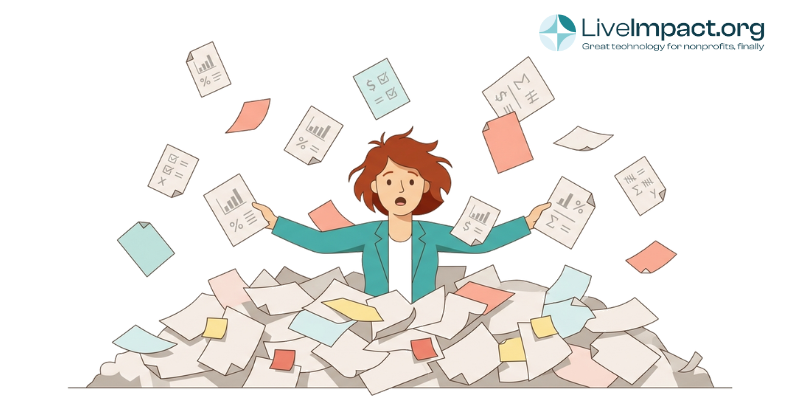
Nonprofit data management is hard. Not because nonprofits don’t care about their data, but because the funding to manage it well rarely exists. There’s no dedicated data person. Systems get set up by whoever had time, and data ends up wherever it landed. By the time a funder report is due or a board member asks a question, someone is manually pulling from three different places and hoping the numbers match.
What Is Nonprofit Data Management?
Nonprofit data management is the practice of collecting, organizing, securing, and using data across all of an organization’s operations. That definition covers a lot of ground: client intake records, case notes, service delivery logs, program outcome metrics, grant compliance documentation, donor relationships, restricted fund tracking, volunteer information, and financial records.
For social services and human services organizations specifically, data management carries more complexity than it does for most nonprofits. These organizations operate across two distinct data worlds: the program side (client records, service history, outcomes) and the fundraising side (donor relationships, grant compliance, restricted funds). Those two worlds rarely live in the same system. Every time a funder asks a question that spans both, someone has to manually bridge them.
Why Nonprofit Data Management Is Getting Harder
The problem is getting measurably worse. According to the 2026 CCS Philanthropy Pulse report, 36% of organizations reported difficulties leveraging data for decision-making in 2025, up from 14% the year before. Data management and CRM issues were cited by 33% of respondents, more than double the 15% reported in 2024.
Several forces are driving this trend. Government and foundation funders increasingly require real-time or near-real-time access to outcomes data, moving well beyond the annual summary model. Organizations managing multiple grants across different funders are effectively operating under several compliance frameworks at once, each with different documentation, reporting, and audit requirements.
Social work and human services agencies face additional layers: many operate under government contracts with specific data collection, retention, and access requirements. HIPAA compliance, case confidentiality protections, and client consent protocols add obligations that general-purpose software was not built to handle cleanly.
Staff turnover makes everything harder. When client records and institutional knowledge live in an individual’s spreadsheet rather than a shared system, that knowledge leaves with the person. And AI tools, which are moving quickly into nonprofit operations, only produce reliable outputs when the underlying data is clean, centralized, and consistently structured.
Types of Data Nonprofits Need to Manage
Most human services nonprofits are managing several distinct data categories simultaneously. Understanding them separately helps clarify why a single system that handles all of them is so valuable.
- Client and case data. Intake records, demographic information, case notes, service delivery logs, consent forms, and case status. For social work organizations, this is typically the largest and most sensitive data category, often subject to HIPAA or state confidentiality requirements.
- Program outcomes data. Metrics tied to program goals and funder-required indicators. Housing programs track placement rates and housing stability. Workforce development programs track job placement and wage outcomes. Food banks track meals served and household reach.
- Grant and funder data. Application records, award letters, reporting deadlines, disbursement schedules, and compliance requirements. Government contracts often carry stricter data requirements than foundation grants.
- Donor and constituent data. Giving history, communication preferences, relationship notes, and major gift pipeline.
- Financial records. Budgets, restricted fund tracking, and expense reporting by program.
- Volunteer data. Hours, roles, engagement history, and background check status.
The core challenge is that these data types almost always live in separate systems. Client records in a case management database. Donor records in a CRM. Grant tracking in a spreadsheet. Every report that crosses those lines requires someone to manually pull and reconcile data from multiple sources.
For organizations running direct service programs, case management software built specifically for nonprofits can consolidate client records, program outcomes, and grant compliance data in one place, which significantly cuts the manual reconciliation work before funder reports are due.
Nonprofit Data Management Best Practices
The organizations that manage this well share a set of practices. None of these require a large technical team. They do require deliberate decisions and someone accountable for following through.
-
Centralize data first.
Data that lives in separate systems creates problems every time you need a complete picture of your organization. Client records in one place, donor data in another, grant tracking somewhere else means every cross-departmental report requires manual assembly. Centralizing your data into a unified platform creates a single source of truth and gives your whole team access to accurate, up-to-date information without chasing it down. This matters especially for client and case records, which tend to be the most sensitive data nonprofits hold. A single system with proper access controls protects that data while making it usable. Once your data is centralized, everything else, reporting, compliance, donor stewardship, gets meaningfully easier.
-
Standardize data entry before attempting cleanup.
Data cleanup after the fact is expensive and time-consuming. Establishing clear entry rules upfront, including field formats, required fields, and naming conventions for programs and services, prevents problems from compounding. For human services organizations, this means standardizing how client demographics are recorded, how service units are counted, and how case status is updated. Document these standards somewhere accessible and build them into new staff onboarding. Relying on institutional memory is how standards disappear when someone leaves.
-
Assign data ownership by department.
When nobody owns the data, nobody maintains it. Assign a named data steward in each department: someone responsible for the accuracy of their team’s records. In a social services agency, this might mean one person owns client intake quality, another owns outcomes data, another owns donor records. This role does not require technical expertise. It requires accountability and a regular check-in rhythm with whoever manages the system overall.
-
Build outcome tracking into your data collection workflow.
Many organizations collect service delivery data and outcomes data in two separate processes, then have to connect them manually at reporting time. Designing your data collection so that outcome indicators are captured as part of normal program operations eliminates that extra step. A workforce development program that records job placement status at case close has its funder report data built in. A housing program that logs move-in dates and stability check-ins does too. This matters especially for organizations operating under government contracts with specific metric requirements. Heller Consulting’s 2026 data governance guide for nonprofits describes this integration of data collection and outcomes tracking as one of the foundational habits of organizations that handle data management well.
-
Run regular data audits, quarterly or more often.
Quarterly spot checks catch errors before they become report-day emergencies. Pull a sample of client records, grant entries, or donor profiles and check for duplicates, missing required fields, and outdated information. Note common errors and address them in team training. For social work organizations with high caseloads, monthly audits of active cases are worth the time investment given the compliance stakes involved.
-
Protect sensitive client data with role-based access controls.
Social services organizations hold some of the most sensitive personal data anywhere: health information, immigration status, housing history, financial records, trauma histories. Role-based access controls ensure staff see only what is relevant to their work, which reduces breach risk, supports client confidentiality, and is often a contractual requirement for government-funded programs. Document your access structure and review it whenever staff roles change.
-
Connect program data to donor and grant reporting.
Organizations that report most effectively to funders are the ones whose program data and fundraising data live in the same system, or at least integrate cleanly. When a foundation asks for outcomes data tied to a specific grant, pulling it directly from the system that manages case records, rather than reconciling two spreadsheets, saves time and reduces the risk of errors. This connection also strengthens donor stewardship: major donors respond to specific impact data, not approximations.
-
Train staff regularly, not only at onboarding.
Most data quality problems trace back to unintentional human error. Short, recurring refreshers on data entry standards, privacy protocols, and system usage keep practices consistent as staff turn over and programs grow. For organizations with high turnover, a documented data handbook that new hires can reference independently is worth creating. Making data stewardship part of performance expectations, rather than just an IT policy, is what keeps standards from drifting.
The Role of Software in Nonprofit Data Management
Spreadsheets are a reasonable starting point for very small organizations, but they break down quickly as programs grow. The moment an organization is managing client records across multiple programs, tracking outcomes for multiple funders, and maintaining donor relationships simultaneously, spreadsheets create more work than they save. Version control problems, formula errors, and access issues compound over time.
Most organizations that outgrow spreadsheets end up with a patchwork: a CRM for donors, a separate database for clients, and grant tracking in email threads or additional spreadsheets. Each system requires its own maintenance. Every report that crosses those systems requires manual export, reconciliation, and quality checking. Staff time gets consumed by the overhead of managing the gap between systems rather than by delivering services.
For social services agencies, housing programs, workforce development organizations, and similar direct service nonprofits, purpose-built nonprofit case management software is usually the right operational foundation. These systems are designed around client and program data, not donor records as a primary use case.
LiveImpact is built specifically for this type of organization. Rather than managing client records in one system and donor data in another, social services agencies and human services nonprofits can track case management, program outcomes, grant requirements, and fundraising in one platform. When a funder asks for impact data tied to a specific program, it is already there, connected to the same records the program team uses every day. A review of the best case management software options for nonprofits can help you understand where integrated platforms fit compared to standalone tools.
Common Nonprofit Data Management Mistakes to Avoid
A few mistakes come up consistently when organizations struggle with data management. Most of them are avoidable.
- Waiting until a funder deadline to determine whether the required data exists
- Treating data cleanup as a one-time project rather than an ongoing organizational practice
- Using a general-purpose CRM that was not built for nonprofit program complexity or case management workflows
- Collecting data that never maps to a report, a decision, or a funder metric
- Skipping documentation of data entry standards and relying on staff memory instead
- Giving all staff unrestricted database access with no role-based permission structure
- Keeping client, program, and donor data in entirely separate systems with no integration plan
Frequently Asked Questions
What is nonprofit data management?
Nonprofit data management is the practice of collecting, organizing, securing, and using data across all of an organization’s operations. For social services and human services organizations, this includes client intake records, case notes, program outcomes, grant compliance data, donor relationships, and financial records. Effective data management ensures that information is accurate, accessible to the right people, and usable for decision-making and funder reporting.
What types of data do social services organizations need to manage?
Social services organizations manage several distinct data categories: client and case records, program service delivery data, outcome metrics, grant and funder compliance records, donor and fundraising data, financial records, and volunteer information. The complexity comes from the fact that these categories typically live in separate systems and have to be manually reconciled whenever a cross-departmental report is needed.
What is the difference between a nonprofit CRM and case management software?
A CRM primarily manages relationships with donors, volunteers, and other constituents. Case management software tracks individual client records, service delivery, outcomes, and program compliance. For social work and human services organizations doing direct service delivery, case management software is usually the operational foundation. Some platforms combine both functions, which eliminates the reconciliation work that comes from running separate systems. For a full comparison, the guide on the best CRM for small nonprofits covers how to evaluate both functions together.
How often should nonprofits audit their data?
Most practitioners recommend monthly spot checks on active records and a comprehensive audit at least once a year. Organizations with high caseloads, government contracts, or frequent staff turnover often benefit from quarterly full audits. Building data audits into the regular calendar as a recurring task, rather than a crisis response before a report deadline, prevents small errors from compounding into larger problems.
What data privacy rules apply to social services nonprofits?
The answer depends on the data you hold and where you operate. HIPAA applies to organizations handling health information. Many government-funded programs carry contractual data requirements on top of applicable laws. State-level data privacy laws vary and are evolving. Organizations handling immigration status, mental health records, or financial assistance data should work with legal counsel to understand their specific obligations. The minimum baseline for any organization is role-based access controls, encrypted storage, and a documented data retention and disposal policy.
Building Better Data Habits Starts Now
Good data management is an organizational habit, not a one-time technology project. Social services and human services organizations that get this right spend less time on administrative reconciliation, report more confidently to funders, and can actually use their data to understand what their programs are accomplishing. If your team is spending days pulling reports that should take hours, it may be worth seeing what an integrated system looks like. Request a demo to see how LiveImpact connects client, program, and donor data for organizations doing direct service work.