

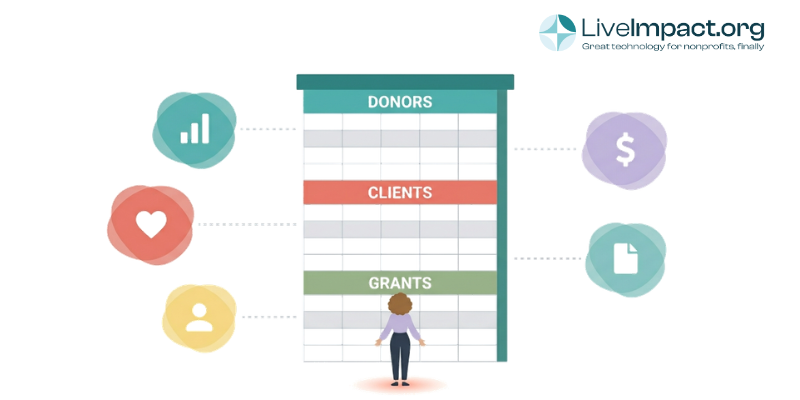
Most nonprofits end up managing two or three separate databases without really planning to. A donor CRM handles giving history. A case management system tracks clients and program activity. A grant tracker lives in a spreadsheet, or sometimes a third tool entirely. Every funder report requires someone to manually reconcile data across all of them, exporting from one system and importing into another just to produce numbers that should already be in the same place.
If that describes your organization, the problem goes beyond any single piece of software. You need a database strategy that fits how your organization functions.
This post covers seven nonprofit database software options worth evaluating in 2026, with honest assessments of who each platform serves best and where the trade-offs are. The list includes both donor-focused platforms, case management tools, grant trackers, and event platforms, because the right answer depends entirely on what kind of data your organization needs to track.
What is nonprofit database software?
Nonprofit database software stores and organizes information about the people and programs central to your mission, including donors, clients, volunteers, members, grants, and outcomes. Most organizations start with a basic donor database or spreadsheet, but as programs grow, they typically end up managing multiple disconnected systems. The right database software centralizes that data, reduces manual reconciliation, and makes funder reporting significantly faster.
That definition matters for evaluating the options below. A search for “nonprofit database software” returns results dominated by donor-focused CRMs. For fundraising-only organizations, that’s the right category. For organizations running direct service programs alongside their fundraising, the database problem is broader: client records, case notes, service tracking, and program outcomes need to live somewhere too. The platforms on this list reflect both realities.
The 7 nonprofit database platforms worth considering in 2026
1. LiveImpact
Best for: Nonprofits running case management programs that also need donor management, grant tracking, and program reporting in a single database.
LiveImpact treats the database fragmentation problem as one problem rather than several. Client records, case notes, donor relationships, grant requirements, and program outcomes all live in the same system. Staff enter data once; it’s available across every function without manual exports or reconciliation between tools. For organizations that receive funding tied to program outcomes, that connection between client data and funder reporting changes how much time a report actually takes to produce.
The platform’s case management tools include client intake, service tracking, assessment forms, and outcome reporting built for funder compliance. The donor management features cover giving history, donor segmentation, campaign tracking, and AI-powered analytics. Both functions share a single database, so a client who later becomes a donor has one complete record rather than two separate entries in disconnected systems.
Pricing is flat-rate, starting around $350 per month with unlimited users. Costs don’t scale with headcount or database size, which changes the long-term math considerably compared to per-user or per-contact pricing models.
Worth knowing: LiveImpact goes deeper on program and case management than on pure major gifts cultivation. Organizations whose primary need is sophisticated moves management or planned giving workflows may find more specialized functionality in donor-centric platforms.
2. Bloomerang
Best for: Small to mid-size nonprofits whose primary database need is donor retention and relationship management.
Bloomerang is purpose-built around donor retention, with engagement scoring that identifies at-risk donors before they lapse. The interface is clean and development staff tend to pick it up quickly. For fundraising-focused organizations with limited program complexity, it delivers a well-designed donor database without unnecessary overhead.
Pricing scales with contact volume, which becomes a meaningful cost driver as the database grows. There’s no case management capability built in, so organizations running direct service programs need a separate system for client tracking.
3. DonorPerfect
Best for: Organizations with established fundraising programs that need deep donor analytics and gift tracking.
DonorPerfect has been in the market for decades and carries broad functionality for major donor management, recurring giving, and gift processing. It fits organizations with dedicated development staff who need detailed giving analytics and flexible reporting. Like Bloomerang, pricing is contact-based. The platform focuses on donor and fundraising data; program or client management isn’t included.
4. Salesforce Nonprofit Cloud
Best for: Large organizations with IT staff and dedicated budget for implementation and ongoing customization.
Salesforce offers the most configurable database on this list. With enough technical investment, it can be built to handle almost any use case, including program management, client tracking, and donor data. The question organizations have to answer honestly is whether they have the resources to build and maintain what Salesforce requires. The comparison between Salesforce and purpose-built nonprofit platforms usually comes down to that tradeoff.
The basic Nonprofit Success Pack (NPSP) is free for qualifying organizations, additional modules are often needed which are priced per user. Implementation costs for full customization can be expensive when using outside consultants. For organizations without dedicated IT staff, that scope is a substantial barrier before a single record is entered.
5. Blackbaud Raiser’s Edge NXT
Best for: Mid-to-large nonprofits with complex fundraising operations and dedicated development staff.
Raiser’s Edge NXT has long been the enterprise standard for major gifts fundraising and donor analytics. It carries deep functionality for prospect research, pledge management, and gift officer portfolios. Organizations with large development teams and sophisticated fundraising programs often find it worth the investment.
Blackbaud publishes pricing by request rather than on their website. Raiser’s Edge NXT runs on the higher end of the market. The platform centers on fundraising and donor management; program management capabilities are limited, and smaller organizations frequently cite cost as a barrier.
6. Neon CRM
Best for: Nonprofits that need donor management, membership, events, and basic fundraising in one platform.
Neon CRM covers more ground than a pure donor database. Event management, membership tracking, and basic grant management come alongside donor data, making it a reasonable option for organizations wanting to consolidate several functions without moving to a full case management platform. Membership and advanced features requiring higher tiers.
Verified user reviews on G2 consistently describe Neon CRM as broad rather than deep in any single area. Organizations with more complex needs in fundraising, case management, or grant tracking tend to find that breadth has limits.
7. CharityTracker
Best for: Community-based organizations that need a shared client database across multiple partner agencies.
CharityTracker fills a specific niche: coordinating services across agencies in a local community. Multiple organizations can access a shared database of client records, track referrals, and avoid duplicating services to the same households. For coalitions or community hubs focused on intake and referral coordination, it serves that function well at a lower price point than most platforms on this list.
The scope is intentionally narrow. Organizations that also need fundraising tools, grant management, or comprehensive donor tracking will need separate software for those functions.
Five factors that separate good fits from costly mistakes
Before requesting demos, these questions tend to surface the clearest picture of platform fit:
- Pricing model over time: Per-user fees grow as your team grows; per-contact fees grow as your database grows. A flat-rate model keeps costs predictable regardless of both. Our nonprofit CRM pricing guide covers how each model plays out over a three-year horizon, including where costs tend to hide.
- Full use case coverage: List every function you need: donor management, client tracking, program reporting, grant compliance, volunteer coordination. Then verify which platforms actually cover all of them, beyond what their marketing materials lead with.
- Customization by non-technical staff: If your programs have unique intake fields, assessment forms, or funder-specific reporting requirements, the platform needs to support customization without developer support or outside consultants. Some tools make this straightforward; others don’t.
- What’s included in onboarding: Data migration and staff training determine whether a transition delivers its promised benefits. Confirm what’s included before signing anything, and ask specifically about historical data import from your current systems.
- Funder report compatibility: If your grants require specific outcome fields or reporting templates, verify before committing that the platform can generate what your funders require without custom workarounds at every reporting deadline.
For organizations running both direct service programs and fundraising, the all-in-one nonprofit software comparison goes deeper on how integrated platforms compare to stacked point solutions across total cost and operational efficiency.
Frequently asked questions
What is nonprofit database software?
Nonprofit database software stores and organizes information about the people central to your organization’s work, including donors, clients, volunteers, and members, along with programs, grants, and outcomes. It replaces spreadsheets and disconnected tools with a centralized system that makes reporting, communications, and day-to-day operations more efficient.
What’s the difference between a nonprofit database and a nonprofit CRM?
The terms overlap but cover different ground. A CRM (constituent relationship management system) focuses on tracking relationships and interactions, typically with donors or members. A nonprofit database is broader: it can include program data, client records, case notes, grant tracking, and outcome reporting alongside donor relationships. Some platforms do both; many specialize in one or the other.
What database software do most nonprofits use?
Small nonprofits often start with a donor-focused CRM like Bloomerang or DonorPerfect. Organizations running direct service programs typically also need a separate client database such as Apricot or CaseWorthy. NTEN’s research on how nonprofits manage donor data consistently finds that most organizations use multiple systems that don’t share data natively. LiveImpact is one of the few platforms combining donor management and full case management in a single system.
How much does nonprofit database software cost?
Pricing varies widely. Donor-focused platforms often start around $125 per month and scale with contact volume. All-in-one platforms like LiveImpact start around $350 per month with flat-rate pricing regardless of user count or database size. Enterprise options like Salesforce and Blackbaud carry significantly higher total costs, with implementation alone often running $40,000 or more. A full breakdown of how each pricing model affects your budget over a multi-year period is covered in our nonprofit CRM pricing guide.
What should a nonprofit look for in a database platform?
Five things matter most: whether the pricing model fits your growth trajectory; whether the platform covers your actual use cases; how much customization is possible without technical staff; what’s included in onboarding and data migration; and whether the system can generate the specific reports your funders require. The small nonprofit CRM comparison is a useful reference for understanding where the real differentiators show up in practice.
Do nonprofits doing case management need a different database than nonprofits focused on fundraising?
Generally yes, if they’re using separate tools for each function. Case management requires structured client intake, case notes, service tracking, and outcome reporting. Most donor CRMs don’t include any of that. The simplest solution is a platform that handles both, so client data and donor data share the same system and staff aren’t reconciling between tools for every funder report.
See how a unified database works in practice
If your organization tracks donor data in one system and client data in another, the hidden cost shows up every time someone has to bridge those two worlds manually. LiveImpact was built to eliminate that gap. Request a demo to see how the platform handles your specific program and fundraising workflows in a single database.