

Ninety-two percent of nonprofits are using AI. Only 7% say it has made a major difference in what their organizations can accomplish. That gap, between near-universal adoption and meaningful results, is what researchers are calling the efficiency plateau. Understanding why it exists is more useful than chasing the next tool.
Adoption is almost universal, but real impact isn’t
In February 2026, Virtuous and Fundraising.AI published the 2026 Nonprofit AI Adoption Report, a benchmark study covering 346 organizations. The headline numbers are striking: 92% use AI in some capacity, but only 7% report major improvements in organizational capability. The remaining 93% fall somewhere in the range of modest efficiency gains or no measurable difference at all.
What does AI adoption really look like for most of those organizations? One person using ChatGPT to draft a donor appeal while the rest of the team runs on manual processes and disconnected systems. The tools exist. The willingness is there. But the structural conditions for meaningful impact are missing, and that gap shows up in the data.
For any nonprofit leader evaluating whether to invest more in artificial intelligence for nonprofits, this report is the place to start. The question it raises is: what do organizations that actually get results with AI have that the others don’t?
The real barrier isn’t the tools
The report finds that 81% of nonprofits use AI individually, with no shared workflows connecting their use across the organization. Nearly half (47%) have zero AI governance policy. These numbers point to something structural. Most organizations have access to AI and the willingness to try it. What’s missing is the foundation underneath.
Gabe Cooper, CEO of Virtuous, described it this way in the report’s release: most organizations are still in the early innings, with one staffer using ChatGPT while the rest of the team is buried in manual processes and disconnected systems. The research uses a useful framing for this: a turbocharged engine installed in a car with broken wheels. The power is there, but it can’t go anywhere.
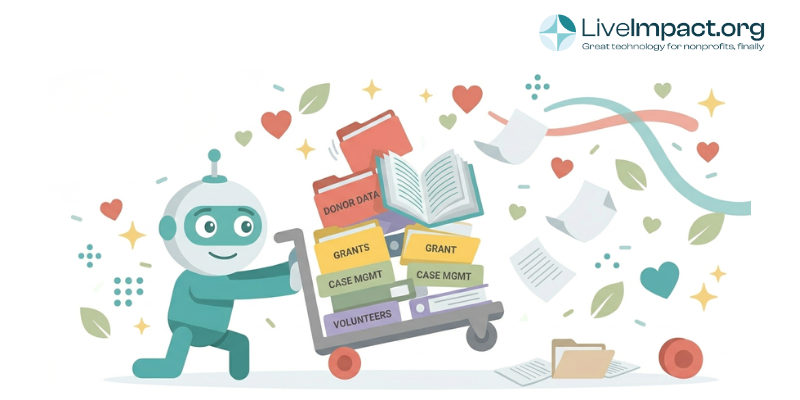
That image captures what fragmented nonprofit tech stacks actually produce. Case management data lives in one system. Donor records sit in another. Grant tracking is in a spreadsheet. Program outcomes and funder reports require manual reconciliation every cycle. When AI tools are layered over this setup, they can speed up individual tasks but they can’t connect the underlying data. Drafting an appeal gets faster. Knowing which donors are at risk, or which program outcomes to highlight for a specific funder, stays just as hard as before.
The 2026 Nonprofit Technology Ecosystem Trends Report from Omatic puts this fragmentation in concrete terms. Seventy percent of nonprofits now manage five or more core technology platforms simultaneously, up from 62% the year prior. Organizations in the family and human services space average 7.1 core applications. That’s seven-plus separate systems, each with its own data, none of them automatically sharing information with the others.
Adding AI to that stack doesn’t solve the problem. It makes it more apparent.
| Capability | AI on fragmented systems | AI on consolidated data |
|---|---|---|
| Draft donor communications | ⬤ Faster drafting | ⬤ Faster drafting + personalized by donor history |
| Identify at-risk donors | ⬤ Limited (data lives in separate systems) | ⬤ Predictive signals drawn from unified records |
| Connect program outcomes to grants | ⬤ Manual reconciliation still required | ⬤ Automated, outcomes tied to funder requirements |
| Shared AI workflows across teams | ⬤ Individual use, no documented process | ⬤ Consistent workflows across functions |
| Organizational-level impact | ⬤ Task-level gains only | ⬤ Structural improvements across operations |
What the 7% are doing differently
The report describes the organizations seeing real results as those where AI has moved from ad hoc individual experimentation into documented, repeatable workflows embedded across functions. They also share something structural: their data flows together.
When program data, donor records, and grant requirements live in one place, AI tools actually have something coherent to work with. Predictive analytics can surface meaningful patterns. Reporting can draw from a single source of truth rather than requiring someone to manually pull and reconcile data from multiple platforms before the actual work can begin. The AI produces better results because the data underneath it is better connected.
This is where good nonprofit data quality practices become foundational rather than optional. Clean, unified data is the input AI needs to produce anything beyond task-level speed gains.
LiveImpact is built around this approach. As a platform designed specifically for nonprofit operations, it consolidates case management software for nonprofits alongside donor management, grant tracking, fundraising, and program reporting in one system. For organizations trying to get past the efficiency plateau, that consolidation provides the structural condition meaningful AI results require. The AI tools may be identical. The differentiator is working from a single, connected data set rather than fragmentary snapshots pulled from six separate platforms.
Organizations evaluating what all-in-one software for nonprofits can actually deliver often focus on the cost and consolidation benefits. Those are real. But for AI specifically, the deeper value is data coherence. That’s what lets AI move from accelerating individual tasks to driving organizational-level improvements.
A practical starting point for most organizations
The Virtuous/Fundraising.AI report is clear that governance and shared systems matter as much as the tools themselves. For organizations still in the early stages, there are three practical steps that tend to surface the clearest path forward.
- Map where your data actually lives. Before adding any AI tools, take stock of every system your team uses regularly. Note which ones share data automatically and which ones require manual exports or copy-paste to bridge. That map will tell you more about your AI readiness than any vendor demo.
- Identify one high-friction workflow. Find a process that eats significant staff time every month, such as pulling a grant progress report, reconciling donor records before a campaign, or manually tracking case notes across programs. That workflow is the clearest test of whether your current systems can support AI or whether the data is too siloed for it.
- Ask the shared workflows question. Individual AI use produces individual speed gains. Organizational impact comes from shared processes and documented use. Ask whether your team has the system infrastructure to build those shared workflows, or whether each person is essentially running their own AI experiment in isolation.
The answers to those questions determine whether your organization is positioned to cross the efficiency plateau or stay on it.
Nonprofits pursue AI for the right reasons: more time for the work that matters, better outcomes for the people they serve. Getting there requires fixing the foundation first. If your team is ready to explore what a unified platform looks like in practice, request a demo and see how LiveImpact connects program data, donor records, and grant reporting in one system.
Frequently asked questions about nonprofit AI adoption
Why aren’t most nonprofits seeing results from AI?
The most common issue is that AI tools are being added on top of disconnected systems. When donor data, program records, and grant tracking live in separate platforms, AI can only optimize small individual tasks. Without unified data flowing through a single system, meaningful impact stays out of reach.
What percentage of nonprofits are using AI?
According to the 2026 Nonprofit AI Adoption Report by Virtuous and Fundraising.AI, 92% of nonprofits now use AI in some capacity. However, only 7% report major improvements in organizational capability, pointing to a significant gap between adoption and actual impact.
What is the nonprofit AI efficiency plateau?
The efficiency plateau describes the gap between widespread AI adoption and meaningful results. Most nonprofits use AI for individual tasks like drafting communications or data lookups, but lack the shared workflows and integrated systems needed to translate that use into organizational-level improvements.
What should a nonprofit do before adopting AI tools?
Start with a data audit. Identify where your program, donor, and financial data currently lives and whether those systems share information. AI produces the most value when it can draw on unified, accurate data. Adding AI tools to a fragmented tech stack typically produces limited, short-lived gains.
How many technology platforms does the average nonprofit manage?
According to the 2026 Nonprofit Technology Ecosystem Trends Report by Omatic, 70% of nonprofits manage five or more core applications. Family and human services organizations average 7.1 core platforms. That fragmentation is one of the primary reasons AI adoption hasn’t translated into consistent results across the sector.
What separates effective nonprofit AI strategies from ones that plateau?
Organizations seeing real AI results share a few traits: they operate on platforms where data is unified across functions, they have documented workflows rather than ad hoc individual use, and they apply AI to high-volume, repetitive tasks first before expanding. Governance and shared standards matter as much as the tools themselves.
Is there nonprofit-specific AI software available?
Yes. Platforms built specifically for nonprofit operations, like LiveImpact, consolidate case management, donor records, grant tracking, and program reporting in one system. That consolidation matters for AI because it gives the tools accurate, connected data to work with, rather than fragmentary snapshots from disconnected platforms.