

Salesforce’s free nonprofit licenses cover the software shell only. Getting a working case management or program tracking setup out of it usually runs $10,000 to $50,000 in configuration costs, sometimes more, plus an ongoing admin to keep it running. That gap between free and functional is where most nonprofit Salesforce budgets land.
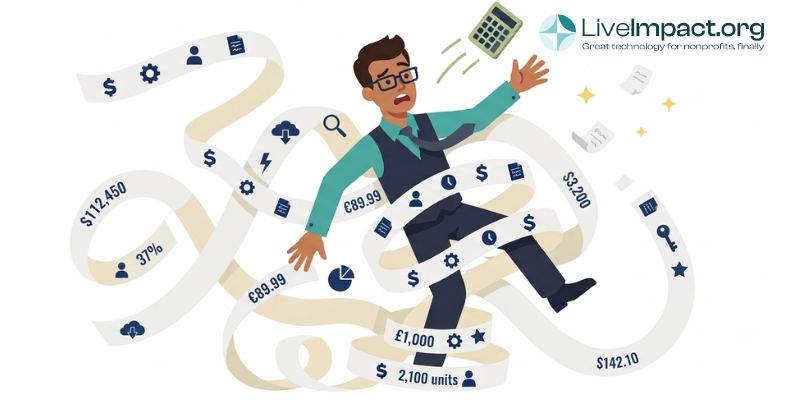
Salesforce shows up on nearly every shortlist, often because a board member used it at a for-profit job and assumes it’s the default choice. For a 15-person org running three programs, that assumption gets expensive fast. The cost shows up less in the license line and more in the person you now need to hire to keep the thing running.
What the free license doesn’t cover
Salesforce’s nonprofit program gives eligible organizations 10 free licenses through the Power of Us program. It’s also where most of the “Salesforce is free for nonprofits” advice stops. In practice, the free licenses are just the starting point.
Salesforce ships as a blank platform with no setup. There’s no case management module, no donor pipeline, no program tracking out of the box; those come from an ecosystem of managed packages (NPSP, and increasingly the newer Nonprofit Cloud), each with its own object model, its own quirks, and its own learning curve. Getting from “we have Salesforce” to “we have a system our case managers use” means configuration work: building record types, setting up page layouts, writing validation rules, connecting the reporting to what your funders ask for.
Someone has to do that work. For a for-profit company, that’s typically a full-time Salesforce administrator, often a certified one, and that’s a real technical hire most nonprofits don’t have room to add. Nonprofits usually can’t budget a dedicated admin role, so the job lands on whoever’s most technical on staff (an ops director, a development manager, sometimes the executive director) on top of their existing responsibilities. When that person leaves, the institutional knowledge of how the org’s Salesforce instance works usually leaves with them, and the next hire inherits a system nobody fully understands.
This is the part vendor comparisons tend to skip, because “free licenses” is a much better headline than “you’ll need someone who understands objects, flows, and validation rules to keep this running.”
The four costs beyond the license
Once the free licenses are activated, four categories of cost tend to appear over the following year.
- Implementation and configuration. Someone maps your intake process, program structure, and funder reports onto Salesforce’s data model, either an internal staff member learning as they go or an outside consultant brought in for the build.
- Ongoing administration. Salesforce instances need regular upkeep: new fields when a funder changes requirements, updated automations, and cleanup when data starts to drift.
- Add-on tools. Program tracking, e-signature, and advanced reporting often live in the AppExchange marketplace as separate paid products layered onto the core platform.
- Training and staff turnover. When the person who understands your organization’s Salesforce setup leaves, the next hire typically has to relearn the system from scratch, since documentation is rarely complete.
None of these show up on Salesforce’s pricing page, because they depend on your organization’s specific programs and funder requirements rather than the platform itself. That’s also why implementation is the part worth budgeting for carefully, more than the license fee itself.
What LiveImpact offers instead
LiveImpact is built for the org that doesn’t have, and doesn’t want to hire, a dedicated admin. Program structures, intake forms, and milestone tracking are set up by LiveImpact’s team during onboarding, and program staff can adjust them directly afterward, without anyone writing declarative logic in Setup. It’s a narrower tool than Salesforce in the sense that you can’t rebuild it into anything imaginable. It’s a wider tool in the sense that a case manager can change an intake form when a funder changes requirements, without looping in an IT consultant.
Here’s how the cost categories typically compare between the two models. For a broader look at how nonprofit CRM pricing structures compare across vendors, see our guide to nonprofit CRM pricing.
| Cost category | Salesforce | LiveImpact |
|---|---|---|
| Subscription | Per-user beyond free licenses, tiered by edition | Flat-rate, unlimited users |
| Implementation | Typically requires dedicated staff time or a consultant | Handled by LiveImpact’s team during onboarding |
| Ongoing admin | Falls to internal staff or a retained consultant | Program staff adjust configurations themselves |
| Add-ons | Many features priced separately in the AppExchange | Core case management and donor tools included |
| Training | Budgeted and sourced separately | Included as part of onboarding |
Cost categories reflect typical implementation patterns. Individual pricing varies by vendor negotiation and organization size.
Pricing is also flat-rate rather than per-user, so seasonal or part-time staff additions don’t change the software bill. A workforce program bringing on job coaches for a summer cohort, or a donor-management team adding a part-time gift processor at year-end, doesn’t have to treat that as a software decision. It’s a smaller factor in the total cost story here than implementation, but it adds up over a few budget cycles. See how LiveImpact’s flat-rate pricing works for more detail.
Where Salesforce wins
For the right organization, Salesforce is the right answer. Nonprofits running multiple business units, integrating with a dozen other systems through APIs, or already staffed with a Salesforce admin get real value from the platform’s depth and its large ecosystem of consultants and integrations. Organizations managing many distinct programs, funding streams, and system integrations, rather than one or two core service lines, are the ones most likely to outgrow more prescriptive platforms and need that flexibility to model genuinely complex, multi-entity operations.
The mistake is smaller orgs inheriting that decision by default, choosing Salesforce because it’s the name they’ve heard, then discovering months in that a growing share of the budget is going toward keeping the CRM alive instead of running programs.
A rough way to tell which side you’re on
Ask three questions before you sit through another demo.
- Do we have someone on staff, today, who could pass a Salesforce Administrator certification exam, or budget for one within a year? If the honest answer is no, factor the cost of an ongoing consultant retainer into your total Salesforce budget, beyond the license fee.
- Does our program structure change often? Orgs that adjust intake forms, funder fields, or reporting requirements multiple times a year need a system where program staff can make that change same-day, rather than one that requires a change request and a build cycle.
- Are we running one core program model, or genuinely disparate business lines? One model, cleanly configurable, favors a purpose-built platform. Several very different lines of business is where Salesforce’s flexibility starts to earn its complexity.
If your honest answers point toward “no dedicated technical staff, changing program needs, one or two core programs,” that’s the org LiveImpact was built for. If your answers point the other way, Salesforce’s depth is worth the admin investment. Our full LiveImpact vs. Salesforce comparison walks through the feature side of that decision, and one nonprofit’s firsthand account of implementing Salesforce covers how the consultant search played out for them.
The question underneath the feature list
It comes down to who is going to run the system on the Tuesday a funder changes a required field two weeks before a report is due. For a lot of small and mid-sized nonprofits, answering that honestly before signing a contract is worth more than any feature comparison.
Frequently asked questions
Is Salesforce really free for nonprofits?
Salesforce’s Power of Us program gives eligible 501(c)(3) organizations free licenses, but the license only covers the software shell. Case management workflows, donor pipelines, and program tracking come from separate managed packages and configuration work, which is where most of the real cost shows up.
How much does Salesforce implementation cost for a nonprofit?
Implementation cost depends heavily on how complex your program structure is and whether you handle configuration internally or bring in a consultant. Using outside help for technology implementation is common among nonprofits: NTEN and Heller Consulting’s 2024 Nonprofit Digital Investments Report found that nearly two-thirds of nonprofits use outside consultants for technology projects at least sometimes.
What’s included in Salesforce’s Nonprofit Success Pack?
The Nonprofit Success Pack (NPSP) provides a basic data model for donor and constituent records. Case management, program tracking, and grant workflows generally require additional building or separate add-on products.
Does LiveImpact charge per user like Salesforce?
No. LiveImpact uses flat-rate pricing with unlimited users, so adding seasonal or part-time staff doesn’t change the software bill the way per-user pricing can.
How long does Salesforce implementation take compared to LiveImpact?
Salesforce implementation timelines vary widely based on configuration complexity and whether a consultant is involved. LiveImpact’s team handles initial configuration during onboarding, which is typically a faster path for organizations without dedicated technical staff.
See how LiveImpact handles program and case management without a dedicated admin.