

Human services organizations often deliver strong results at the program level but struggle to grow their reach, sustain funding, or add new programs without things breaking down. The bottleneck is rarely staff effort or mission clarity. It’s almost always data: how it’s collected, stored, and reported across programs.
The Scaling Problem Human Services Organizations Face
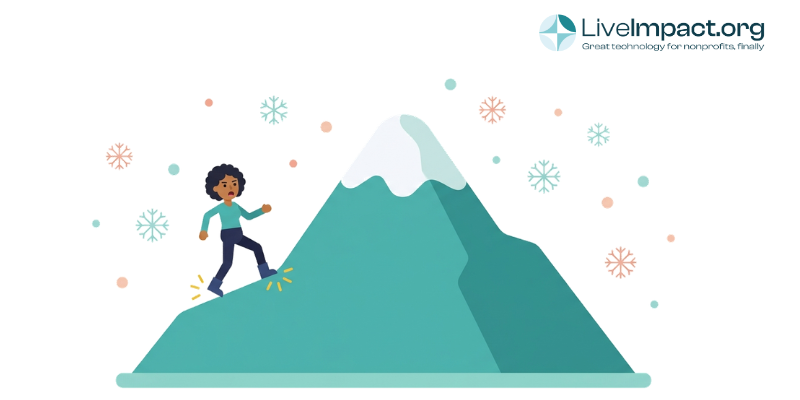
The mission is clear. The staff is committed. But add a second housing program, a workforce development track, or a new youth services contract, and something starts to slip. Case notes pile up. Reporting takes longer. Supervisors lose visibility into what’s happening across programs. The organization hasn’t grown weaker. The systems underneath it just weren’t built for this level of complexity.
According to Agency Forward research from Nationwide, more than 69% of human services providers have had to turn away or stop accepting new referrals due to insufficient staffing. That statistic gets cited frequently in conversations about workforce capacity. But understaffing is only part of the story.
As CUNY’s Institute for State and Local Governance documents, demand for human services is increasing across childcare, eldercare, and housing support, driven by pandemic-era disruptions, affordability pressures, and aging populations, with jurisdictions increasingly relying on nonprofits to fill that gap. The organizations that can absorb that demand are the ones with operational infrastructure that grows with them, not just more headcount. The organizations that can’t are usually managing data in ways that worked at three programs but collapse at six.
Four Reasons Human Services Programs Hit a Growth Ceiling
1. Client Data Lives in Too Many Places
Multiple programs, multiple spreadsheets, multiple staff members keeping their own records. When a client moves between programs (from emergency housing to workforce development, for instance), their history doesn’t follow them. Staff duplicate intake work. Supervisors can’t see the full picture. Funders ask questions no one can answer quickly.
The NTEN and Heller Consulting 2024 Nonprofit Digital Investments Report found that improving inefficient processes and saving staff time ranked near 90% as the top drivers of technology investment decisions across the sector. Human services organizations consistently ranked among those with the smallest technology budgets relative to their overall budgets, meaning the inefficiencies compound over time without the infrastructure investment to address them.
The result is a data environment that grows more fragmented with each new program. Staff work around the gaps as best they can, but the hidden cost accumulates in duplicated intake work, missed service history, and client relationships that have to be rebuilt from scratch every time someone new picks up a case.
2. Reporting Takes Longer Than the Work It’s Supposed to Describe
Grant reporting is one of the most time-consuming activities in any human services organization. Staff pull data from different sources, reconcile inconsistencies, and manually compile reports that funders use to decide whether to renew contracts. The organizations doing the best work often have the hardest time proving it because their data infrastructure was built for service delivery, not structured outcome reporting.
The Nonprofit Finance Fund’s 2025 State of the Nonprofit Sector Survey found that 85% of organizations expect service demand to increase in 2025, while 36% ended 2024 with an operating deficit, the highest in ten years of NFF survey data. When those two pressures collide (more demand, tighter margins), hours spent on manual reporting are hours pulled directly from mission delivery.
Funders and regulators increasingly expect organizations to demonstrate outcomes with specific, comparable metrics. The organizations that can pull clean data on short notice are better positioned for renewals, audits, and new funding opportunities.
3. Staff Turnover Erases Institutional Knowledge
Human services has persistent staffing challenges across the sector. A fall 2024 survey published by Candid’s Social Impact Staff Retention project found that 67% of nonprofit employees were looking for new jobs or would be within a year, well above all-industry averages. When a case manager leaves, their caseload doesn’t just transfer. The context, the history, the nuance of each client relationship has to be rebuilt from scratch.
If case notes live in personal documents, a shared drive only one person knew how to navigate, or a legacy system with no searchable history, the next staff member starts from zero. That data loss compounds the capacity loss from the departure itself.
A 2023 survey by the National Council of Nonprofits found that nearly 75% of nonprofits reported persistent job vacancies, particularly in program and service delivery roles. Every one of those vacancies carries a data continuity risk alongside the obvious capacity risk. The organizations that weather turnover best are the ones where the case record lives in the system, not in someone’s head or personal folder.
4. Adding Programs Means Reinventing Everything
Each new program often brings a new intake form, a new tracking method, a new reporting template built to satisfy that particular funder. Over time, an organization ends up with five programs running five different data systems, none of them talking to each other. Leadership can’t see aggregate impact. Funders can’t see the whole organization. Staff administering all of it spend more time managing systems than serving clients.
This pattern tends to emerge gradually. The first program built what it needed. The second adapted what the first built. By the time a third or fourth program launches, the patchwork is so specific to each program that consolidation feels impossible. Organizations that hit this ceiling often describe the same experience: they know they’re doing good work, but they can’t prove it in a way that’s scalable or fundable.
What Scaling Actually Requires (Beyond Hiring More Staff)
The organizations that successfully expand their programs share a few operational patterns worth examining:
- A single client record that follows the client across programs. One profile, not a separate record per program, so service history travels with the client.
- Intake processes consistent enough to produce comparable data. Programs can have different questions, but the structure needs to produce reportable outcomes.
- Reporting that runs without manual assembly. Data already captured in the system, not pulled from spreadsheets the week a grant report is due.
- Case notes that are searchable, attributable, and accessible to supervisors. When a staff member leaves, their caseload doesn’t become a mystery.
- Outcome tracking tied to specific funder metrics. Purpose-built fields for the data funders actually ask for, not generic fields mapped manually at report time.
This infrastructure is buildable in spreadsheets for one program. It breaks down at two or three. At five or six programs, maintaining it becomes a full-time job on its own.
LiveImpact’s program case management is built specifically for human services organizations running multiple programs, with configurable intake, cross-program client records, and funder-ready reporting in a single platform. It connects the dots between programs without requiring a separate system for each one.
What to Look For in Case Management Software for Human Services
If your organization is ready to move beyond disconnected systems, these are the capabilities that matter most for human services work at scale:
- Cross-program client records. One profile per client tracking all services, so staff avoid duplicating intake and supervisors can see the full picture.
- Configurable intake forms. Each program has different data requirements. Forms should adapt to those requirements without IT support or custom development.
- Outcome tracking tied to grant metrics. Funder-specific fields built in, not generic fields mapped manually at reporting time.
- Audit-ready documentation. Timestamped case notes with staff attribution, accessible to supervisors and reviewable during compliance reviews.
- Reporting dashboards. Pull grant compliance data on demand without spreadsheet reconciliation.
- Role-based access. Field staff, program managers, and executives see the data appropriate to their role, not a flat view of everything.
- Mobile access. For case managers documenting in the field, not just at a desk.
For more on how these features apply in practice, see our posts on how case management software streamlines intake and assessment processes and measuring nonprofit impact using case management software.
Frequently Asked Questions
What is human services case management software?
Human services case management software is a platform that helps social services organizations manage client intake, track service delivery, document case notes, and report outcomes across programs. Unlike general nonprofit CRMs, it is built around the client journey from first contact through service completion, rather than around donor or membership relationships.
How is human services software different from a nonprofit CRM?
A nonprofit CRM tracks relationships with donors, volunteers, and supporters. Human services software tracks the services delivered to clients: intake assessments, service plans, case notes, referrals, and outcomes. Organizations serving both donors and program participants often need both, or a platform that handles both in one place. LiveImpact’s donor management and case management features operate within the same system.
What types of organizations use human services case management software?
Human services software is used by food banks, homeless services providers, workforce development programs, domestic violence shelters, community health organizations, substance use recovery programs, and youth development agencies. Any organization managing ongoing client relationships across structured programs is a candidate.
How does case management software help with grant reporting?
Purpose-built case management software stores outcome data in structured fields tied to program and funder requirements. When a grant report is due, the data is already captured and can be pulled without manual spreadsheet compilation. This reduces reporting time and lowers the risk of inconsistencies that can jeopardize renewal.
Can small human services nonprofits afford case management software?
Pricing varies significantly across platforms. Some charge per user, others by program or client volume. For small organizations, the more relevant comparison is software cost against the staff time currently spent on manual data management and reporting, which often exceeds what purpose-built software costs. LiveImpact uses flat-rate pricing with no per-user or per-contact fees, which makes costs more predictable for smaller organizations. See the LiveImpact pricing page for details.