

Most nonprofits treat volunteers and donors as two separate audiences. Volunteer coordinators manage one list. Development staff manage another. And somewhere in the middle, valuable information slips through the cracks.
The volunteer who showed up every Saturday for six months? Development never knew about her. The donor who gave generously for years? The volunteer team had no idea he wanted to get more involved. These missed connections happen constantly, and they cost organizations relationships, revenue, and trust.
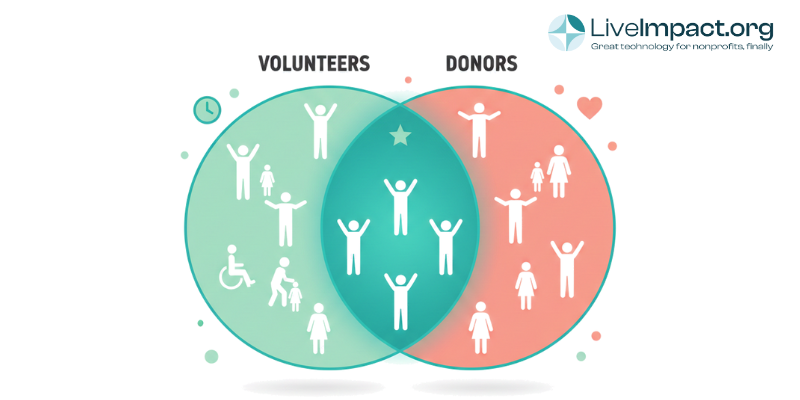
When volunteer and donor data live in the same system, everything changes. You stop guessing who your most engaged supporters are. You stop sending generic appeals to people who already know your work intimately. And you stop treating your warmest prospects like strangers.
The research backs this up. According to the 2025 Bank of America Study of Philanthropy, conducted with the Indiana University Lilly Family School of Philanthropy, volunteers give more than double the average donations compared to non-volunteers. Separate research from the Do Good Institute at the University of Maryland found that people who volunteered in the previous year were 14.5 percent more likely to give in the current year. Your volunteers are already primed to become donors. The question is whether your systems help you see that, or hide it.
Why Separated Data Creates Blind Spots
Picture this: your food pantry has a dedicated volunteer who has helped with distribution every week for two years. She knows the clients by name, understands your operations deeply, and clearly believes in the mission. But because her information lives in a volunteer spreadsheet that never syncs with your donor database, your development team sends her the same cold acquisition email they send to everyone else.
That email lands in her mailbox with no acknowledgment of her service, no recognition of her commitment, and no personalized connection to the work she already does. She tosses it. And your team never realizes they just missed an opportunity to deepen a relationship with someone who was already invested.
This scenario plays out in reverse, too. A major donor expresses interest in getting more hands-on with your work. They mention it casually at an event, but that information never reaches the volunteer coordinator. Months pass. The donor assumes you forgot about them, or worse, that you only value their checkbook.
These blind spots emerge whenever volunteer and donor information live in different systems, managed by different teams, with no shared view of the whole person.
What Changes When the Data Connects
When volunteer tracking and donor management share a single system, you gain something powerful: a complete picture of each supporter’s relationship with your organization. You can see who gives time, who gives money, and who does both. You can see patterns that would otherwise stay hidden.
Consider how this shifts your outreach strategy.
For volunteers who have never donated, you can approach them differently than you would approach a cold prospect. They already know your work. They have seen the impact firsthand. Your appeal can acknowledge that connection and invite them to support the mission in an additional way, with full respect for what they already contribute.
For donors who have never volunteered, you can extend invitations that feel personal rather than transactional. You know they care about the cause. Now you can offer them a chance to experience it more directly, which often deepens their commitment and increases their long-term giving.
For supporters who give both time and money, you can recognize the full scope of their generosity. These are your most engaged advocates. They deserve communication that reflects how much they do, not fragmented messages that only acknowledge part of their involvement.
Practical Benefits for Development Directors
Development directors face constant pressure to identify warm leads, demonstrate ROI, and retain existing donors. When volunteer data feeds into the same system as giving history, several things become easier.
First, segmentation gets sharper. You can build appeal lists based on engagement patterns that include volunteer activity. Someone who volunteered at your gala and gave a modest gift last year might be a stronger prospect for a mid-level ask than someone who gave a larger gift but has no other touchpoints with your organization.
Second, stewardship becomes more personal. When you can see that a donor also volunteers with your after-school program, you can reference that in your thank-you calls and letters. You can invite them to events that align with their hands-on involvement. You can make them feel seen as a whole person, not just a line item in your database.
Third, reporting gets richer. Boards and funders often want to understand the full picture of community support. When you can show volunteer hours alongside giving totals, you demonstrate broader engagement with your mission. You can calculate the estimated value of volunteer time and include it in grant narratives. You can tell a more complete story about how your community invests in your work.
Practical Benefits for Volunteer Managers
Volunteer managers often feel disconnected from fundraising conversations. They coordinate schedules, onboard new helpers, and track hours, but they may not see how their work connects to revenue. When volunteer and donor data live together, that connection becomes visible.
For volunteer managers, unified data means less duplicate entry. When a volunteer signs up through a form that feeds directly into your CRM, you do not have to copy that information into a separate spreadsheet. When they log hours, those hours appear in the same system where development staff can see them. The administrative burden drops, and the data stays cleaner.
Unified data also means better reporting. Grant applications often ask for volunteer statistics alongside program outcomes. When your volunteer hours, donor support, and program data all live in the same place, pulling those reports becomes straightforward. You spend less time hunting through different files and more time actually managing your volunteer team.
Perhaps most importantly, unified data helps volunteer managers understand how their work contributes to organizational sustainability. When you can see that several of your most reliable volunteers have also become donors, you recognize the value of the relationships you are building. You can communicate that value to leadership and advocate for the resources your program needs.
What This Looks Like in Practice
Imagine a youth mentoring program that relies heavily on volunteer mentors. In a fragmented system, the volunteer coordinator tracks mentor attendance in one tool, the development director tracks donations in another, and the two lists never meet.
In a unified system, here is what becomes possible:
- The development director can see which mentors have been active for more than a year and have never received a fundraising appeal. She can craft a message that thanks them for their service first, then gently invites them to consider a gift that supports the same young people they already work with.
- The volunteer coordinator can see which donors have expressed interest in mentoring. He can reach out with a personal invitation, knowing that this person already cares enough to give financially.
- The executive director can pull a report showing total community investment: volunteer hours valued at the current Independent Sector rate, plus total donations, plus in-kind contributions. That report tells a compelling story for the board and for funders.
- When a mentor-turned-donor receives a year-end thank-you, it acknowledges both their financial gift and their hours of service. They feel recognized for everything they contribute, not just part of it.
None of this requires heroic effort. It requires a system designed to hold volunteer and donor data together, and a team that commits to using it consistently.
How to Start Bringing Your Data Together
If your volunteer and donor information currently live in separate places, the transition does not have to happen all at once. Here are some steps to consider:
Audit your current systems. Where does volunteer information live right now? Where does donor information live? How, if at all, do they connect? Understanding your starting point helps you plan a realistic path forward.
Identify your highest-value integrations. You may not need every piece of volunteer data in your donor system. Focus on the information that would most improve your outreach: names, contact details, total hours, programs served, and length of involvement. Start there.
Get volunteer and development staff talking. Unified data works best when both teams understand what the other needs. Volunteer managers can explain which metrics matter most for their reporting. Development staff can explain how they would use volunteer information to personalize outreach. Building that shared understanding early prevents frustration later.
Choose a system that supports both functions. Not every CRM handles volunteer tracking well. Not every volunteer management tool connects to donor records. Look for a platform designed to hold both, with clear pathways for information to flow between them.
Commit to consistent data entry. A unified system only works if people actually use it. Build habits around entering volunteer information promptly and completely. Make it easy for volunteers to sign up and log hours in ways that feed directly into your central database.
The Bigger Picture: Relationships Over Transactions
Behind all the practical benefits of unified data lies a deeper principle. Your supporters are whole people. They do not think of themselves as “volunteers” on Tuesday and “donors” on Thursday. They think of themselves as people who care about your mission and want to help it succeed.
When your systems reflect that wholeness, your communication can reflect it too. You stop sending fragmented messages that acknowledge only part of someone’s involvement. You start building relationships that honor everything a person contributes.
That shift matters for retention. Supporters who feel seen and appreciated stay engaged longer. They give more generously over time. They become advocates who bring others into your community.
It also matters for trust. When you reference someone’s volunteer service in a fundraising appeal, you demonstrate that you pay attention. When you invite a donor to volunteer based on their stated interests, you show that you listen. These small moments of recognition build the kind of loyalty that sustains organizations through difficult seasons.
Making the Case for Change
If you are considering a move toward unified volunteer and donor data, you may need to make the case to leadership or colleagues who are comfortable with the current setup. Here are a few points that can help:
Staff time has real costs. Every hour spent copying volunteer information from one system to another is an hour not spent on programs or relationships. Every error introduced by manual data transfer creates downstream problems. A unified system reduces that friction.
Missed opportunities have real costs. When development staff cannot see who your most engaged volunteers are, they cannot cultivate those relationships intentionally. When volunteer managers cannot see which donors want to get more involved, they miss chances to deepen engagement. Those missed opportunities add up.
Fragmented communication has real costs. Supporters notice when your messages feel disconnected. They notice when you fail to acknowledge their involvement. They notice when you treat them like strangers. That kind of communication erodes trust and reduces retention.
A complete picture supports better decisions. Leadership needs accurate information about community engagement to plan strategically. When volunteer and donor data live in separate silos, that picture stays incomplete. Unified data gives everyone a clearer view.
Moving Forward With Confidence
Connecting volunteer and donor data does not require a massive technology overhaul or a complete restructuring of your teams. It requires a commitment to seeing your supporters as whole people and building systems that reflect that commitment.
Start with the relationships you already have. Look at your most dedicated volunteers and ask whether development has the information they need to cultivate those relationships. Look at your most generous donors and ask whether your volunteer team knows about their interest in getting involved.
Then build from there. Choose tools that support integration. Establish workflows that keep data flowing. Train your team to use the unified system consistently. And watch as your outreach becomes warmer, your asks become smarter, and your relationships become stronger.
At LiveImpact, we believe that volunteer tracking and donor management belong together. Our platform is designed to give you a complete view of every supporter’s engagement, so you can honor their contributions fully and cultivate relationships that last. If you are ready to bring your volunteer and donor data into one place, reach out to us to see how we can help.