

Your donor relationships are the driving force that carries your mission forward. When those relationships live in spreadsheets scattered across laptops, shared drives, and email threads, something breaks. Gifts get miscoded. Thank-you letters go out late. Major donors receive generic appeals instead of the priority attention they deserve.
Spreadsheets feel safe at first. They’re familiar, inexpensive, and everyone on your team already knows how to use them. For small organizations with a handful of supporters, they can work fine for a while.
Then your fundraising grows. You add recurring donors, launch peer-to-peer campaigns, coordinate events, and juggle multiple grant deadlines. The cracks appear fast.
This guide walks through why spreadsheets collapse under real fundraising pressure, what modern donor database software does differently, and how to make the switch without overwhelming your team or budget.
When Spreadsheets Start Breaking Down
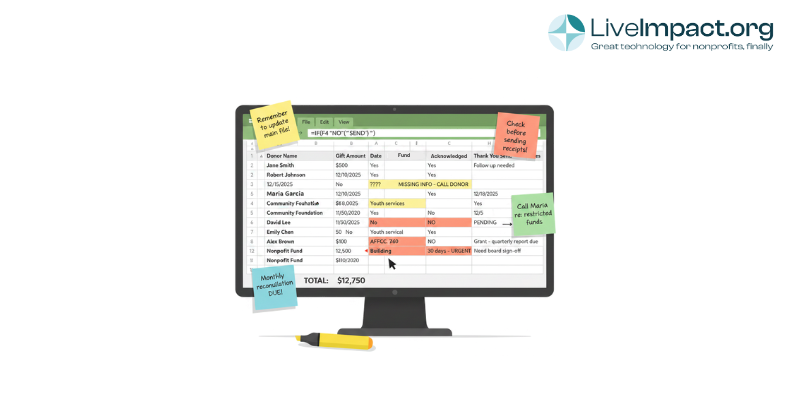
Most development directors recognize this pattern. You’re managing year-end appeals while preparing board reports and tracking grant deliverables. Your donor information exists in:
- Old Excel files on a shared drive that three people update
- Individual staff member’s laptops with slightly different versions
- Email attachments from last quarter that may or may not reflect current data
- Handwritten notes from donor meetings that never get entered anywhere
The trouble starts small. Someone sends acknowledgment letters using last year’s file. A board member’s company matching gift doesn’t show up in the records. Two staff members both update the same donor’s address, but in different files.
Small errors multiply quickly. Here’s what happens:
Duplicate records pile up. Jane Smith, J. Smith, and Jane M. Smith all exist as separate entries. You’re not sure which record has the current phone number.
Contact information goes stale. Donors move, change email addresses, or update their giving preferences. Those changes get noted somewhere, but not everywhere. Your next appeal goes to an old address.
Gift history gets fragmented. A donor’s five-year giving pattern lives across multiple spreadsheets. You can’t easily see their total lifetime giving or spot the trend that they always increase their gift in December.
Staff waste hours finding data. “Does anyone have the updated vendor list?” “Which version has the corrected event registrations?” “Can someone send me the cleaned donor file?” These questions eat up time that could go toward actual fundraising.
For program managers tracking client services alongside fundraising, the chaos gets worse. You need to connect who funded what program, which clients received services, and what outcomes you can report back to funders. Spreadsheets force you to manually cross-reference everything.
The Real Cost of Spreadsheet Donor Management
The problems go deeper than messy data. Spreadsheet dependency creates three major risks that directly hurt your fundraising results.
First, you lose donor trust through avoidable mistakes.
Picture this: A longtime supporter makes a gift in memory of her late husband. Your acknowledgment letter thanks her for “supporting our annual fund” with no mention of the memorial designation. She feels invisible. That relationship just got harder to maintain.
Or a monthly recurring donor’s credit card expires. Your spreadsheet doesn’t flag it. Three months pass before anyone notices the lapsed payments. The donor feels forgotten and stops giving entirely.
These situations damage relationships that took years to build. According to the Fundraising Effectiveness Project, donor retention rates average around 43% across the sector. When you lose supporters because of data problems rather than genuine disinterest, you’re making retention even harder.
Second, compliance and reporting get risky.
Grant funders want detailed reports showing exactly how their dollars were used. They ask for specific metrics: number of clients served, outcomes achieved, timeline of activities. When your program data lives in one spreadsheet, your donor data lives in another, and your financial records live in a third system, connecting those dots becomes a manual nightmare.
Restricted gifts create legal obligations. You promised certain donors their money would fund specific programs. If you can’t easily track restricted versus unrestricted funds, you risk compliance violations that could threaten your nonprofit status or damage funder relationships.
Audit season becomes brutal. Your board or an external auditor asks for a report showing all gifts over $5,000 in the last fiscal year, including dates, purposes, and acknowledgment dates. How many spreadsheets will you need to search? How confident are you that the data is complete?
Third, your team burns out on manual tasks.
Development directors already face intense pressure. You’re expected to increase revenue, retain more donors, diversify funding sources, and show measurable impact. All while working with limited budgets and small teams.
Adding hours of spreadsheet maintenance to that load is unsustainable. Staff spend evenings reformatting data for mail merges, weekends tracking down discrepancies, and board meeting mornings frantically pulling reports together.
When talented development professionals leave nonprofits, they often cite burnout as a major factor. Research from CompassPoint on nonprofit workforce challenges shows that administrative burden contributes significantly to staff turnover. Every hour spent wrestling with spreadsheets is an hour not spent building donor relationships or developing strategy.
Why Growth Breaks Spreadsheet Systems
Small organizations can sometimes manage with spreadsheets. Once you cross certain thresholds, the system fails.
Volume overwhelms manual tracking. When you have 50 donors and run two fundraising campaigns per year, you can probably keep everything straight in your head and in a single spreadsheet. At 500 donors running monthly email appeals, quarterly direct mail, annual events, peer-to-peer campaigns, and major donor cultivation, you need real database infrastructure.
Complexity demands integration. Modern fundraising happens across multiple channels. Donors might:
- Give through your website using a credit card
- Mail a check in response to your newsletter
- Attend your gala and bid in the silent auction
- Participate in your peer-to-peer walk
- Set up monthly recurring gifts through bank transfer
- Ask their employer to match their donation
Each of these transactions might get recorded in a different place. Your online donation platform exports one spreadsheet. Event registration software exports another. Monthly giving gets tracked in a third file. Matching gifts are in someone’s email.
Stitching this together manually means constant copying, pasting, and praying you don’t introduce errors.
Team coordination requires shared infrastructure. Different people need different views of the same donor data:
- Your development director needs to see giving capacity and cultivation strategy
- Your executive director needs board-ready reports on fundraising progress
- Your program manager needs to connect donors to program outcomes
- Your finance director needs to reconcile gifts to accounting records
- Your communications coordinator needs segmented lists for targeted appeals
With spreadsheets, you either give everyone access to one master file (where anyone can accidentally delete critical data), or everyone maintains their own version (which guarantees the versions will diverge and create confusion about which data is correct).
What Donor Database Software Actually Solves
Modern donor database software does what spreadsheets can’t. It treats donor management as relationship management, not just transaction tracking.
You get a complete relationship history in one place.
Click on any donor’s name and see:
- Every gift they’ve made, including date, amount, fund designation, and payment method
- All email and mail communications they’ve received from you
- Event registrations and attendance records
- Volunteer hours and engagement activities
- Notes from phone calls, meetings, and personal interactions
- Household relationships and soft credit for couples or families
This complete view means you walk into every donor conversation prepared. You know what they care about, how they prefer to be reached, and what they’ve supported in the past.
Routine tasks happen automatically.
Set up templates and rules once, then let the system handle:
- Thank-you letters and tax receipts sent immediately after gifts arrive
- Pledge reminders sent before payment due dates
- Recurring gift processing every month without manual intervention
- Birthday or anniversary acknowledgments that make donors feel remembered
Automation removes the risk of forgotten receipts during your busiest seasons. It also frees up staff time for higher-value work like donor meetings, campaign strategy, and program development.
Data stays clean and connected.
Good donor database software prevents common errors:
- Duplicate detection flags when you’re creating a record for someone who already exists
- Required fields ensure you always capture critical information
- Validation rules catch formatting mistakes in email addresses or phone numbers
- Audit trails show who changed what data and when
The system becomes your single source of truth. Everyone on your team sees the same information, updated in real time.
Reporting goes from painful to simple.
Need to know:
- Total revenue by fund for the fiscal year?
- Donor retention rate compared to last year?
- Average gift size for your direct mail campaign versus your email campaign?
- List of lapsed donors who gave two years ago but not since?
These reports take minutes instead of hours. You can slice your data by campaign, fund, donor segment, gift size, date range, or dozens of other criteria. When your board asks questions, you have answers.
You can connect fundraising to mission impact.
Integration between donor management and program tracking lets you show funders exactly what their support accomplished. You can link:
- Specific grants to the programs they funded
- Donor contributions to client outcomes in those programs
- Volunteer hours to service delivery metrics
When a foundation asks what their $50,000 grant achieved, you can report not just that you spent it correctly, but how many clients received services, what outcomes they experienced, and what difference the funding made. This kind of impact reporting strengthens relationships with institutional funders and makes renewal conversations much easier.
Making the Move Without Breaking Your Team
Switching from spreadsheets to donor database software feels like a big lift. It doesn’t have to overwhelm your team or blow your budget.
Begin with honest assessment.
Gather your development team and ask what problems cause the most pain right now. Common answers include:
- We can’t easily see who gave last year but not this year
- Grant reporting takes forever because data lives in multiple places
- We’re embarrassed by how often we send donors the wrong appeal or miss tribute acknowledgments
- Our board wants better metrics and we can’t produce them quickly
Prioritize the problems that hurt most. You don’t need to solve everything on day one.
Choose what matters most for your organization.
Different nonprofits need different features. Consider:
- If donor retention is your biggest challenge, look for systems with strong communication tracking and automated acknowledgment workflows
- If grant compliance keeps you up at night, prioritize fund accounting integration and restricted gift tracking
- If you run a lot of events, make sure the system handles ticketing, registration, and auction management well
- If major donor relationships are your bread and butter, look for robust contact management and moves management tools
Create a short list of must-have features and a longer list of nice-to-have features. This makes vendor evaluation much clearer.
Plan a phased rollout.
You don’t have to migrate everything at once. Many organizations follow this pattern:
- Import active donors and gift history from the past two years
- Set up current campaigns and fund designations
- Train staff on basic donor lookup and gift entry
- Add communication templates and automated receipts
- Bring in historical data, volunteers, and program connections over the following months
Running both systems in parallel for a transition period is normal. Staff can reference old spreadsheets while building confidence in the new system.
Invest in training that matches your team.
The most sophisticated software fails if your staff can’t use it comfortably. Look for:
- Role-based training so people learn the features they’ll actually use
- Documentation written in plain language, not technical jargon
- Responsive support when questions come up
- User communities where you can learn from other nonprofits
For less tech-savvy team members, extra hand-holding during the first few weeks makes a huge difference. Consider assigning a “database champion” on your team who becomes the go-to person for questions.
Calculate the real ROI
Yes, donor database software costs money. Most nonprofit systems run between $1,000 and $10,000 annually depending on your organization’s size and needs. That feels like a lot when you’re used to free spreadsheets.
But consider what you gain:
- Staff time saved from manual data entry, duplicate cleanup, and report building (how many hours per week at what hourly cost?)
- Improved donor retention (if you retain just 5% more donors year over year, what’s that worth in retained revenue?)
- Reduced risk of compliance violations or audit findings
- Better grant reporting leading to stronger funder relationships and renewals
- Fewer donor service failures that damage relationships
According to NTEN’s Nonprofit Technology Staffing and Investments Report, organizations that invest in appropriate technology infrastructure typically see returns through improved efficiency, better decision-making, and stronger stakeholder relationships.
When you account for these benefits, the investment often pays for itself within the first year.
What Better Donor Data Makes Possible
Picture your next fiscal year with donor database software in place.
Your year-end campaign launches. Segmented appeal letters go out automatically based on giving history. Recurring donors get one message. Lapsed donors get another. Major donors receive personal outreach. Every gift triggers an immediate acknowledgment with proper tribute language when applicable.
You wake up on January 2nd and run a complete campaign report in five minutes. You know total revenue, average gift size, response rate by segment, and how this year compared to last year. Your board meeting presentation practically writes itself.
A foundation emails requesting an update on the program they funded. You pull their grant report showing exactly how their dollars were allocated, which clients received services, and what outcomes were achieved. The report goes out the same day. They’re impressed by your responsiveness and clear impact tracking.
Your executive director asks about donor retention. You pull a dashboard showing retention rates by cohort, identify which donor segments are strongest, and spot trends that inform next year’s strategy. The conversation shifts from guesswork to data-informed planning.
A longtime supporter calls with questions about their giving history. Your development coordinator pulls up their complete record while they’re on the phone. She can see every gift, every communication, notes from the last major donor visit. The supporter feels known and valued. The relationship deepens.
This isn’t fantasy. Hundreds of nonprofits experience this reality after moving beyond spreadsheets to proper donor database software.
Your Donor Relationships Deserve Better Infrastructure
Spreadsheets served you well when your organization was smaller. They let you start tracking donors without spending money you didn’t have. That was the right tool for that season.
You’ve grown since then. Your mission has expanded, your programs serve more people, and your fundraising has become more sophisticated. The tools need to grow too.
Continuing to force spreadsheets to do work they weren’t designed for puts stress on your data, your donors, and your team. Every manual workaround, every version control confusion, every missed acknowledgment chips away at the relationships that fund your mission.
Modern donor database software removes that stress. It protects your data, supports your team, and helps you care for donors the way they deserve.
You’re not behind for still using spreadsheets. You’re exactly where many organizations have been. The question is whether your current tools match the fundraising work you need to do this year and next.
Build Stronger Donor Relationships With the Right Tools
If you’re ready to move beyond spreadsheet chaos into clear, confident donor management, we can help. LiveImpact’s donor database software gives you complete visibility into every relationship and every gift. Our platform is built specifically for nonprofits like yours—organizations that need sophisticated fundraising tools without enterprise-level complexity or cost.
We make it simple to track donor history, automate acknowledgments, connect gifts to programs, and report on impact. Your team gets the infrastructure they need to focus on relationships instead of data cleanup.
Learn more about our donor management features and see how LiveImpact can support your mission.