

You know the drill. Another grant report is due next week, and you’re staring at spreadsheets scattered across five different files, sticky notes with client outcomes, and that sinking feeling that you’re missing something critical. Your program director needs the numbers for the board meeting. Your grant officer is asking for specific outcome data from Q3. And somewhere in all of this, you’re supposed to be helping the 30 families on your caseload. If this sounds familiar, you’re not alone. Social services organizations face mounting pressure to demonstrate impact while managing limited resources and growing caseloads. Funders want data. Boards want results. And your team wants to spend less time on paperwork and more time with the people you serve. Case management software for social services changes everything by centralizing your data, automating reports, and helping you demonstrate impact in ways that secure funding.
The Funding Challenge Facing Social Services Organizations
Getting grant funding is hard enough. Keeping it is even harder.
Research shows that 70% of social services organizations report increased demand for their services, yet many struggle to demonstrate their impact in ways that satisfy funders. The challenge isn’t that your programs don’t work. The challenge is proving it with the kind of data funders now expect.
Traditional methods like spreadsheets, paper files, and disconnected systems create several problems:
- Staff spends hours hunting down information across multiple locations instead of focusing on client care
- Data entry happens twice or three times because systems don’t talk to each other
- Grant reports take days instead of minutes when program managers scramble to manually compile outcomes from dozens of case files
- Critical information gets lost in the shuffle between paper forms, email attachments, and various spreadsheets
The result? Reports that take days to create instead of minutes, data that’s incomplete or inconsistent, and missed opportunities to show the real impact of your work.
Funders are paying attention to these gaps. They want to see measurable outcomes, not just outputs. They need assurance that their investment creates lasting change. And increasingly, they’re making funding decisions based on organizations’ ability to demonstrate impact through solid data.
What Funders Actually Want to See
Understanding what funders look for in reports helps you deliver exactly what they need. Most funders evaluate grants based on several key criteria:
- Clear outcome data that shows real change in clients’ lives. This goes beyond counting how many people you served (outputs) to showing how those people’s situations improved (outcomes). Did housing stability increase? Did employment rates improve? Did families remain intact?
- Consistency across reporting periods. Funders want to see that you’re tracking the same metrics over time so they can evaluate trends and long-term impact. Inconsistent data collection makes it impossible to show whether your programs are improving or where adjustments might be needed.
- Transparency and responsiveness. Funders appreciate organizations that can quickly provide detailed information about specific programs, populations served, or time periods. When you can answer their questions without a two-week delay to manually pull data, you build trust and credibility.
- Financial accountability. Funders need to see that resources are being used efficiently and that the cost per successful outcome is reasonable. This requires connecting program activities to both client outcomes and budget expenditures.
- Storytelling backed by data. Funders want to understand the human impact through client stories while also seeing the quantitative evidence that your intervention works at scale.
How Case Management Software for Social Services Transforms Impact Reporting
Case management software for social services addresses these funder requirements by centralizing your data and automating much of the reporting process. Instead of piecing together information from multiple sources, everything lives in one secure, organized system.
The transformation starts with consistent data collection. Software guides staff through standardized intake forms, assessments, and outcome measurements. This ensures that every case manager collects the same information in the same way, creating reliable data you can actually use for reporting.
Real-time outcome tracking becomes possible when your system automatically calculates metrics as cases progress. You don’t wait until the end of the quarter to see if clients are hitting their goals. You can monitor success rates, identify struggling cases, and intervene early when needed.
Automated reporting features save enormous amounts of time. Instead of spending four days manually compiling a grant report, you can generate it in 20 minutes. The software pulls exactly the data your funder requested, formats it consistently, and presents it in professional reports or dashboards.
One social services director put it this way: “We used to spend the last week of every quarter just trying to get our numbers together for our funders. Now I can pull a report in the time it takes to make coffee. That’s time we’re spending with clients instead of at our desks.”
Audit trails and compliance features give funders confidence in your data integrity. The system tracks who entered information, when they entered it, and any changes made over time. This level of documentation satisfies even the most stringent grant compliance requirements.
The Specific Features That Make Impact Demonstration Easier
Not all case management software is created equal when it comes to funder reporting. The right system includes several essential capabilities:
- Customizable outcome tracking lets you measure what matters to your specific funders. Whether you’re tracking housing stability for a HUD grant, employment outcomes for workforce development funding, or family preservation metrics for child welfare grants, the software adapts to your needs.
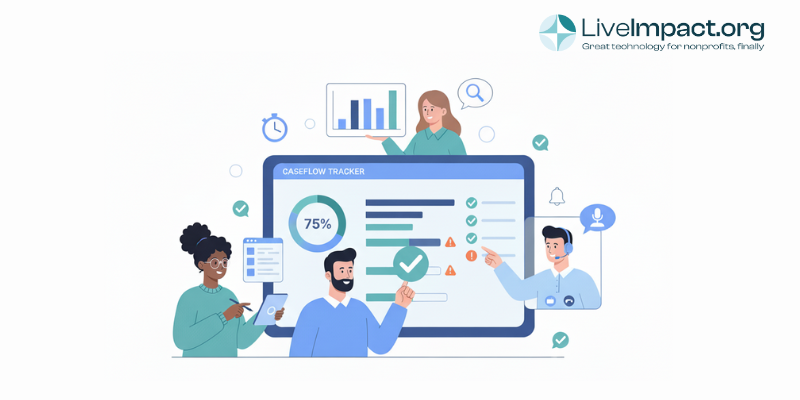
- Dashboard visualization tools turn raw numbers into compelling stories. Instead of sending funders a 50-page spreadsheet, you can share interactive dashboards that show trends, progress toward goals, and comparisons across programs or time periods. Visual data is easier for board members and funders to understand and remember.
- Filter and segment capabilities allow you to slice your data in multiple ways. Need to show outcomes specifically for single mothers ages 18-25 in your employment program? Or track how many families avoided eviction after receiving rental assistance? Good software lets you filter by demographics, services received, time periods, or any other relevant factor.
- Grant-specific reporting templates save time by pre-configuring reports for common funder requirements. Many organizations receive funding from multiple sources with different reporting formats. Software that stores templates for each funder means you’re not starting from scratch every quarter.
- Data validation features catch errors before they reach funders. The system can flag incomplete records, inconsistent entries, or missing required information. This quality control prevents embarrassing mistakes in grant reports and ensures your data stands up to scrutiny.
Real Data That Funders Care About
Case management software for social services helps you track and report on the specific metrics that impress funders and demonstrate true impact:
Client outcome measures show the actual changes in people’s lives. These might include increases in income, improvements in housing stability, reductions in crisis incidents, gains in educational achievement, or progress toward self-sufficiency. The software tracks these metrics consistently across all clients, making it easy to report success rates and average improvements.
Service utilization data helps funders understand efficiency. They can see how many services each client receives, the average length of time in your program, and which interventions lead to the best outcomes. This information helps you demonstrate that you’re using resources wisely.
Demographic reporting ensures you’re reaching the populations funders care about most. You can easily show the diversity of clients served, verify that you’re meeting target population requirements, and identify any gaps in service delivery.
Cost per outcome metrics demonstrate financial efficiency. When you can show that your program helps families achieve housing stability for $X per family, or helps youth complete education programs for $Y per graduate, funders can evaluate your cost-effectiveness compared to other programs.
Progress tracking over time reveals trends and sustainability. Funders want to know that positive changes last beyond program completion. Software that tracks clients over extended periods can show sustained employment, stable housing, or continued family wellness months or even years after services end.
From Data to Funding: Making Your Case
Having good data is only half the battle. You need to present it in ways that compel funders to continue or increase their investment.
Start by understanding each funder’s priorities and tailoring your reports accordingly. One foundation might care most about reaching underserved populations, while a government grant focuses on compliance and specific outcome benchmarks. Your software should let you emphasize different metrics for different audiences without changing your underlying data collection.
Tell stories with your numbers. Include brief client success stories that illustrate your quantitative results. When your data shows that 78% of families avoided homelessness, share the story of one family whose life changed because of your program. This combination of data and narrative creates a compelling case.
Show continuous improvement by comparing results across time periods. Funders appreciate organizations that learn from their data and adjust programs accordingly. If your software shows that outcome rates improved from 65% to 78% after you implemented a new intervention, share that evolution.
Be transparent about challenges alongside successes. If certain populations had lower success rates, show what you learned and how you’re addressing it. This honesty builds trust and demonstrates that you’re using data to improve services, not just to look good.
Connect outcomes to funder goals. Explicitly link your results to what your funders care about most. If they fund you to reduce recidivism, lead with your recidivism rates. If they care about cost-effectiveness in healthcare, emphasize cost savings and reduced emergency room visits.
Beyond Compliance: Using Data to Strengthen Programs
The impact of case management software for social services extends well beyond satisfying grant requirements. The same data that impresses funders also helps you improve service delivery:
- Identify what works and scale it across your organization. When your software shows that certain interventions or approaches lead to better outcomes, you can train all staff in those methods and replicate success.
- Spot problems early through trend analysis. If outcome rates start declining or certain client populations show concerning patterns, your dashboards alert you before these become major issues.
- Make informed decisions about program design using evidence from your own services. Data might reveal that clients who receive a specific combination of services have higher success rates, guiding you to restructure programs for maximum impact.
- Allocate resources more effectively by understanding which programs generate the strongest outcomes relative to their cost. This helps you make strategic decisions about where to invest limited funds.
- Engage staff in data-driven practice by giving case managers access to their own performance metrics. When staff can see their client outcomes and compare them to organizational averages, it motivates improvement and creates healthy accountability.
Choosing Social Services Case Management Software That Delivers Results
Not every case management system will help you demonstrate impact effectively. Look for several critical features when evaluating options:
- Purpose-built for social services. The system should be specifically designed for social services organizations, not generic business software adapted for nonprofit use. Purpose-built solutions understand the unique reporting requirements of social services grants and the specific outcomes you need to track.
- Intuitive and easy to use. If your case managers find the system confusing or time-consuming, they won’t enter complete data, and your reports will suffer. Look for intuitive interfaces that match how your team actually works.
- Flexible reporting capabilities. You should be able to create exactly the reports each funder needs without requiring technical expertise. You shouldn’t need a data analyst to pull a simple outcome report.
- Strong security and compliance. The software must protect sensitive client information and meet HIPAA, FERPA, and other relevant standards. Funders need assurance that client data is safe in your hands.
- Solid training and support. The vendor should provide comprehensive training and ongoing support to ensure your team can actually use all the features. The best software in the world doesn’t help if your staff doesn’t know how to use it effectively.
- Integration capabilities. Your case management software should connect with financial systems, donor databases, or other tools so information flows seamlessly without creating another data silo.
Taking the First Step
Moving from spreadsheets and paper files to modern case management software for social services feels like a big leap. Many organizations worry about implementation costs, staff resistance to change, or data migration challenges.
These concerns are valid, but they’re also manageable with the right approach and the right partner. Organizations that successfully implement case management software typically follow these steps:
- Get clear on your goals. What do you want to achieve? Faster grant reporting? Better outcome tracking? More time for direct service delivery? Starting with clear objectives helps you evaluate options and measure success.
- Involve your team early in the process. Case managers, supervisors, and grant writers all have valuable input about what features matter most. Their buy-in during selection makes implementation much smoother.
- Start with a pilot program if possible. Test the software with one program or team before rolling it out organization-wide. This lets you work out kinks, refine workflows, and build internal champions who can help train others.
- Plan for adequate training and allow time for adjustment. Your team needs support as they learn new systems. Budget time for initial training and ongoing questions as people get comfortable with new workflows.
- Recognize that the investment pays off quickly. Yes, there’s an upfront cost in time and money. But organizations typically see returns within months through time saved on reporting, improved grant success rates, and better program outcomes that lead to increased funding.
The Bottom Line: Your Mission Deserves Better Tools
Every day, social services organizations change lives. You help families find stable housing. You support youth in crisis. You provide essential services that keep communities healthy and strong.
This work matters too much to be hampered by outdated systems that bury your impact in spreadsheets no one has time to compile. When you can’t easily demonstrate your results, you risk losing funding for programs that work. When staff spends hours on manual data entry, that’s hours they’re not spending with clients who need them.
Case management software for social services gives your team the tools to do what they do best while also telling your impact story in ways that secure the funding you need to keep serving your community.
The organizations that thrive in today’s competitive funding environment aren’t necessarily the ones with the biggest budgets or the flashiest programs. They’re the ones that can clearly demonstrate impact, respond quickly to funder questions, and continuously improve based on solid data.
That capability is within reach for organizations of any size. The question is whether you’re ready to stop spending your time fighting with spreadsheets and start spending it on what matters: serving your community and showing funders the difference you make.