
A case management model determines the approach a program uses to help clients: how much the case manager does directly, how often they meet, and how many clients each one carries. The four most common case management models are brokerage, clinical, strengths-based, and intensive. The right one depends on how complex your clients’ needs are and how much staff time you have.
This guide is for anyone setting up or running a case management program.
What is a case management model?
A case management model is the overall approach a program takes to that work. It sets how hands-on the case manager is, how often staff and clients are in contact, and whether the plan starts from problems to fix or from strengths to build on.
Picture two programs. In the first, a case manager meets a client once, makes a few referrals by phone, and checks back a month later. In the second, a case manager visits the same client at home several times a week. Both go through intake, planning, and monitoring, yet the day-to-day work looks nothing alike.
Programs have room to choose. A SAMHSA advisory based on TIP 27 says a treatment program can select the case management model that matches its treatment approach. Plenty of programs blend models, which we’ll get to below.
Case management itself has become standard practice in some fields. The same SAMHSA advisory reports that the share of U.S. substance use disorder treatment facilities offering case management rose from 66% of 13,418 facilities in 2000 to 83% of 15,961 facilities in 2019. It also cites a 2019 meta-analysis that found a small but statistically significant positive effect for case management compared with treatment as usual.
What are the four main case management models?
The four main case management models are brokerage, clinical, strengths-based, and intensive. The psychiatric nursing textbook from OpenStax describes these four as evidence-based case management models, and they differ mostly in who the case manager is and how closely they work with each client.
Brokerage case management
In brokerage case management, the case manager assesses what a client needs and connects them to services other organizations provide. The Massachusetts Department of Mental Health calls this “standard case management” in its September 2025 case management best practices report, built around needs assessment, referrals, and monitoring.
It suits clients whose needs are fairly clear, such as someone who needs help applying for benefits or finding a job training program. Contact is short, so one case manager can serve many people. The tradeoff is follow-up. When a referral is the main service, it’s hard to know whether the client got help or what happened next.
Clinical case management
In clinical case management, the person coordinating a client’s services is also one of their clinicians, such as a therapist or nurse. The case manager handles referrals and planning while also providing direct treatment.
OpenStax notes that the closer relationship can support client motivation, and that clinical case managers see fewer clients because each relationship takes more time. This model fits behavioral health programs and medical settings. Its main limit is staffing, since it needs people with clinical training and usually a license.
Strengths-based case management
Strengths-based case management builds the plan around what a client already does well and what they want for themselves. According to OpenStax, it was developed in response to concerns that earlier models focused mainly on clients’ limitations.
The case manager helps the client name their own goals, spot their strengths, and build informal support from family, friends, and community. It takes more time per client than brokerage, and OpenStax points out that a heavy focus on the positive can cause a case manager to miss serious problems.
Intensive case management
Intensive case management gives clients with complex or urgent needs frequent, hands-on support from staff who carry small caseloads. OpenStax describes it as designed for people with severe mental illness and as resource-intensive.
The Massachusetts DMH report gives a sense of the scale: an intensive case management team works with fewer than 20 clients, who are seen one to three times per week for an open-ended period. The same report describes assertive community treatment (ACT), a team-based relative of intensive case management in which a multidisciplinary team provides integrated psychiatric treatment in the community. Both approaches are expensive to staff.
How do the models compare side by side?
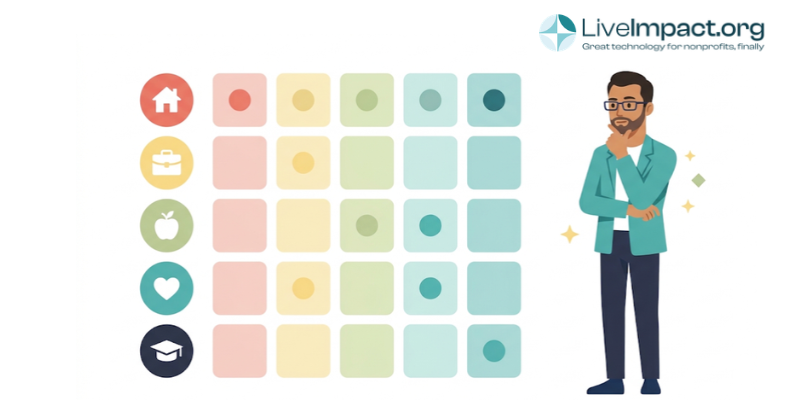
Lined up from least to most hands-on, the order runs brokerage, strengths-based, clinical, and intensive.
Moving right on that scale means smaller caseloads and higher cost per client. Moving left lets you reach more people with the same staff, with less contact for each one.
How do you know which model your program already uses?
You can usually tell which model your program uses by looking at how often staff see clients, what they do in those meetings, and how many clients each person carries. These five questions will point you in the right direction:
- How many times do staff usually meet a client? Once or twice points to brokerage.
- Do staff provide counseling or therapy themselves? If yes, that points to clinical case management.
- Do plans start from client goals and strengths, or from problems to fix? Goals and strengths point to a strengths-based model.
- How many clients does each case manager carry? Small caseloads with daily or weekly contact point to intensive case management.
- Where does the work happen? Mostly in the community or at clients’ homes leans intensive or strengths-based.
If your answers point in two or three directions, that’s normal. Most programs land somewhere in a blend.
Which case management model is best for your program?
No single case management model is best for every program. The right fit depends on your clients’ needs, your staff’s training, your funding, and what your program is trying to achieve. Here’s a starting point by program type:
- Food and basic needs programs often use brokerage, since most clients need a specific resource and a quick connection.
- Housing and shelter programs range from brokerage to intensive, depending on the population.
- Behavioral health programs tend toward clinical or intensive case management.
- Youth and reentry programs often use a strengths-based model.
- Multi-service agencies usually blend models, with a different approach for each program.
Check your grant terms before you change anything. Some funders and payers require a specific model or a minimum contact frequency, and switching approaches mid-grant can put compliance at risk.
Can you combine case management models?
Yes, and many programs do. A team might use strengths-based practice inside an intensive case management program, setting goals in the client’s words while still meeting several times a week.
A common pattern for small and mid-sized nonprofits looks like this: brokerage for lower-need clients, and a more intensive approach for clients with complex needs, all inside the same agency.
The practical side matters here. When models differ by program, each program needs its own intake questions, note format, and contact schedule.
How does your model change what you document and report?
Your model decides what your case managers write down, because each approach puts the weight on different parts of the work.
In a brokerage program, referral records matter most. Staff need to log where each client was sent, whether the referral was accepted, and what happened after.
Clinical case management adds session notes and treatment plans to the record, and those records need tighter privacy controls than most program data.
Strengths-based programs document goals in the client’s own words, strengths assessments, and progress toward each goal. Our guide to case notes examples and templates shows how different note formats handle this.
Intensive programs generate the most records: frequent contact logs, crisis notes, and notes that keep a whole team coordinated on the same client.
Reporting follows the same pattern. Funders often ask for different outcomes depending on the model, such as completed referrals for a brokerage program or housing stability over time for an intensive one. Your records need to match your approach so the numbers you report hold up. For more on choosing the right measures, see our guide to nonprofit outcomes tracking.
How does software support different case management models?
One system can support programs with different models when each program can set up its own forms, fields, note templates, and workflows without technical staff.
LiveImpact lets each program set its own intake forms, case note formats, and reports while keeping one client record across every program.
If you’re sorting out how your programs should run day to day, take a look at LiveImpact’s program case management software to see how it handles different approaches in one place.
Frequently asked questions
What are the 4 types of case management?
The four main types of case management are brokerage, clinical, strengths-based, and intensive. Brokerage connects clients to outside services with brief contact. Clinical combines case management with direct treatment. Strengths-based builds plans around client goals and abilities. Intensive provides frequent, hands-on support with small caseloads for people with complex needs.
What is the difference between brokerage and strengths-based case management?
Brokerage case management focuses on assessing needs and referring clients to other services, usually with one or two contacts. Strengths-based case management is an ongoing relationship where the case manager helps clients identify their own strengths and goals. Brokerage serves more people per staff member, while strengths-based work takes more time per client.
What is intensive case management?
Intensive case management is an approach for people with serious or complex needs, such as severe mental illness or long-term homelessness. Case managers carry small caseloads and see clients often. The Massachusetts DMH describes teams serving fewer than 20 clients, seen one to three times per week, for as long as support is needed.
Is clinical case management the same as therapy?
Clinical case management includes therapy or other treatment, plus the coordination work of case management. The case manager is also one of the client’s clinicians, such as a therapist or nurse, so they handle referrals and planning alongside direct care. That’s why this model requires clinical training and usually a professional license.
Which case management model is most common in nonprofits?
Most nonprofits blend models. Brokerage is common in programs that connect people to basic resources, while strengths-based practice shows up often in youth and reentry work. Agencies with several programs frequently use brokerage for lower-need clients and a more intensive approach for clients with complex needs.
Do you need special software for a specific case management model?
You don’t need separate software for each model. You need a system where each program can set its own intake forms, note formats, contact schedules, and reports. That flexibility lets a referral program and an intensive program run in the same system while keeping one shared record for each client.